

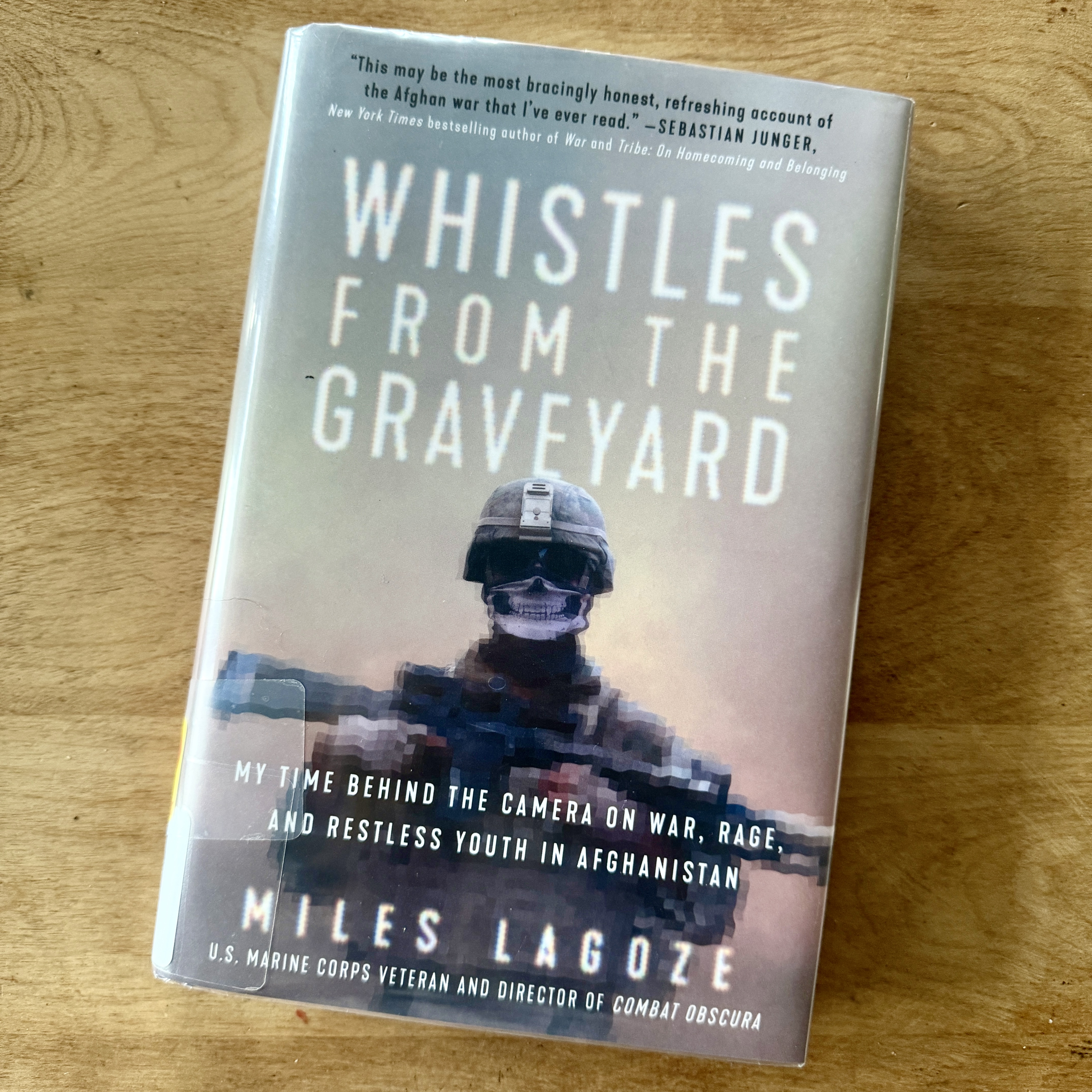
I have respect for anyone who joins the military. I could have but didn’t. My father tried but was rejected. Same for my grandfather who had Ankylosing Spondylitis. But don’t you worry about gramps. He wrote for forty years and could still fish with the best of them. He also wore floral pattern pants and hiked his underwear up to just under his pecs. No idea why but it seemed to work for him. Miles Lagoze’s “Whistles from the Graveyard,” is about being in the military, as a member of “Combat Camera,” to be specific, but the picture it paints is not the picture we were expecting.
But before we go any further, I want you think back to when you were eighteen.
Or “AAAYYDEEN” if you are Australian. Me, I was a total mutant. A total mess. Barely capable of feeding and fending for myself. I’m guessing that at least some of you were the same. Now imagine going into the military and being surrounded by fellow eighteen year olds. And now throw in a hostile, foreign environment, commanders bent on mission at hand, and lots and lots of guns. It is only logical to imagine things going a bit sideways.
Lagoze is part of Combat Camera which means he doesn’t entirely fit in. The troops he is embedded with view him with both fondness and distrust. Lagoze’s take on social media and the acceptance of things like Avatar are fascinating and illuminating. He also becomes immediately confronted with the reality he is filming his fellow soldiers doing all kinds of things their commanders and the public would be repulsed by. There is the treatment of local Afghans, opium and hash use, the abuse of children, and the list goes on.
Lagoze decides to film it all.
I “enjoyed”this book. Revealing is how I would describe it, but there is one piece of this complex puzzle that needs to be addressed. Again. What happens to these boys when they return from the field. It’s not pretty, not pretty at all. Suicide rates, DUI’s, domestic violence, depression, PTSD, is rampant. It’s heartbreaking to hear about his fellow soldiers, and in fact, his own battle with substances and reentry. The people who most need to read this are the gung-ho types who were never in the military, and those who tune out anything to do with war. Get it, read it.
Comments 8
This sounds like an interesting read so it will go on my list of books to read this year. Even though I was deployed to Iraq twice and Africa once, I was fortunate to have not been too harshly exposed to the realities of war. Having rockets launched over our heads and in our compound was one thing. Having to actually get up close an personal is something entirely different.
Still, I’ve seen enough to know that I wouldn’t want to test my mental strength to the extent that our troops that routinely go “outside the wire” did on a daily basis. Just grazing the action was more than enough for me.
Thank you for the book recommendation!
Author
I can’t even imagine. Heck, you went. That’s all that matters. I’ve been shot at a few times and that was enough.
I went through basic training at 27. Spent my 30th birthday in Iraq.
My biggest takeaway after being a civilian again for almost 20 years is what I call a “hard vs soft” transition.
I came home, had a light duty month or 2 then went right into training for another tour. This scenario is worlds different in every important metric to exiting combat and being a civilian 2-weeks later. I also managed to escape without seeing much action. Pure luck as we were on the road 2 to 3 times per day. I look back on my blip in the Army with a mix of fondness and WTF was I thinking?
Author
You are a badass. Plain and simple. You did it and lived to tell about it.
Thank you, Dan., I appreciate the sentiment. When I hit 55, my service will officially be a segment smack in the middle of my life. To put a different perspective on things, my 20-year-old nephew was out for a run last month and ended up doing a marathon because he “felt good.” Ah youth.
Author
Yes, I vaguely remember those days. Dirt roads and Meatballs on repeat.
There is a photo book entitled SHOOTER by Air Force Combat Camera photojournalist, Stacy Pearsall. Embedded with Army troops her photos are excellent. She was wounded twice, i believe, and medically retired. She suffers from PTSD and as part of her rehab undertook the Veterans Portrait Project where she takes portraits of vets of all services and wars. Combat Camera in war and conflict ain’t glamorous. Google her and find out.
Author
I think I read that….