
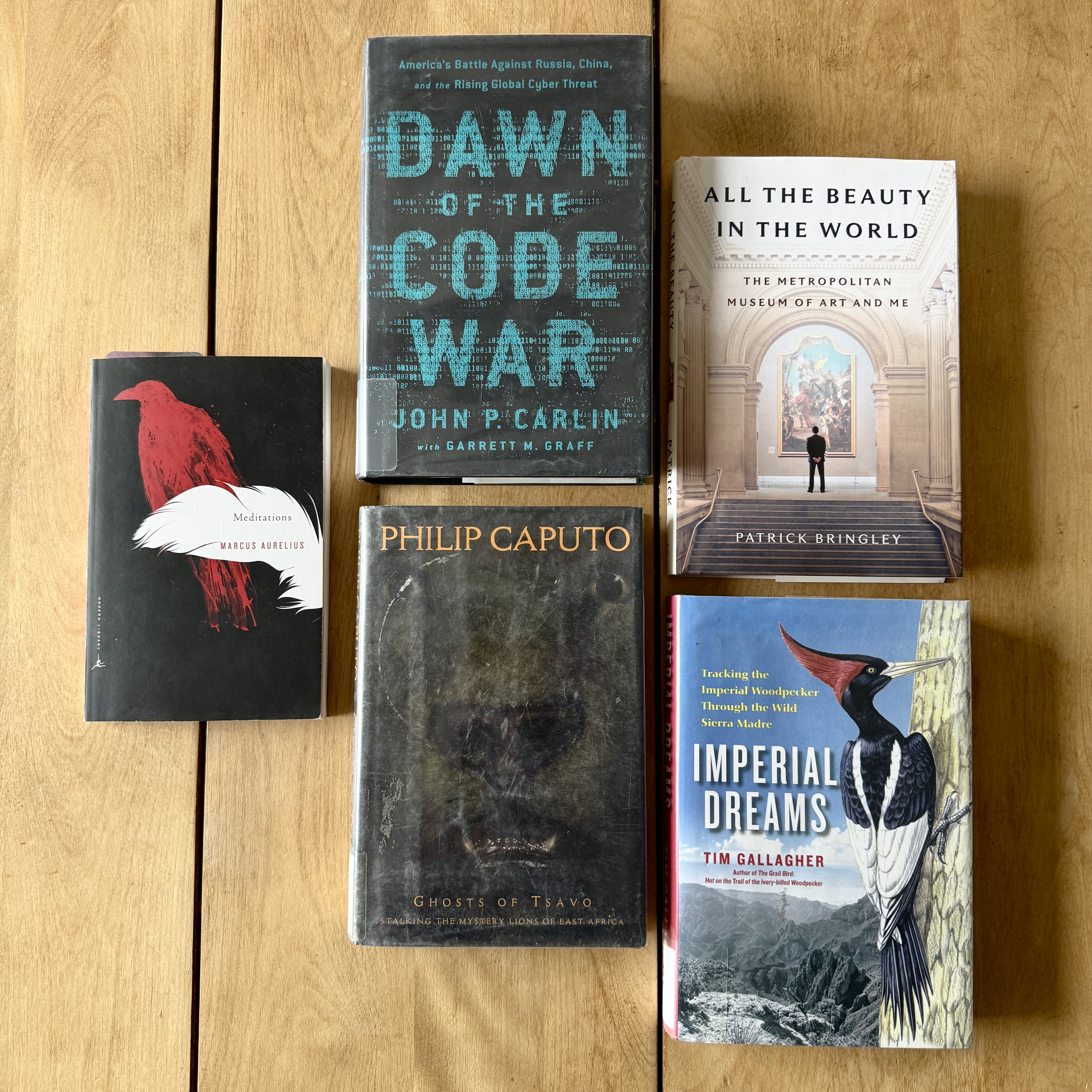
It’s been a slow month for reading. I typically don’t read much when I’m traveling for work, but that’s okay. I get back to it when I return home and set that alarm. Some of these books were recommendations, and one was even purchased for me. Thanks, Kentucky Slim. Others are books by authors I love. So, let’s get to it.
Starting at the top and working our way down.
Dawn of The Code War by John Carlin is a thick and hearty taste of what’s been happening in cyberwar from the perspective of an American government worker. In terms of titles and positions with our cyberwar government offices, Carlin was up there, bouncing from agency to agency, attending super sensitive cyberattack meetings, and designing and implementing policy. It’s ugly. If you thought things were bad, they are worse than you can imagine. Our typical foes are present, but the complexity of attack, our slow response, and the lack of political will don’t bode well for the future. Stock up because when things go bad, they will do so in epic fashion.
All the Beauty in the World from Patrick Bringley came with high praise. “I’ve been rereading chapters,” my friend said. That’s rare, and that’s a good thing. Bringley is a writer who ends up taking a job as a museum guard at the Metropolitan Museum of Art in New York. The book is the result of his ten years of observations. This book has many poignant moments, some dealing with art and some dealing with family, guard culture, and museum operations. There are also plenty of observations about us, the general public. There are moments of hilarity and moments of calm. At the core, too, is the idea of art itself.
If I had a dollar for every person who recommended Meditations by Marcus Aurelius, I’d be able to fly Economy Plus. Business would still be out of the question. This is NOT a book you read once. It’s not a book you read in one go. This is a book requiring time and thought. Read a paragraph and think. Repeat.I like philosophy. Almost majored in it but came to my senses and chose photography, something far more practical and realistic. (That noise you hear is my parents sobbing from the grave.) Reading this book is the easy part. Adapting to its ideology is where things get tricky.
I love Philip Caputo. Rumor of War, Horn of Africa, DelCorso’s Gallery, Crossers, and the list goes on. Ghosts of Tsavo is about Africa and, more specifically, lions. Maneaters. I love books that blend history with first-person reporting, and that is precisely what this book does. (Authors, please do more of these.) I’ve not yet ventured to the lion-rich parts of Africa, but this book made me want to chuck it all and buy a one-way. Adventure is at the heart of this book. We need more of this. Turns out, at the time of his writing, there was still a bit of mystery surrounding African lions, especially those who developed a taste for humans. Why did they develop the taste?
Who doesn’t love someone who will brave the raging fire of psychotic narcos to look for a potentially extinct bird? This is precisely what Tim Gallagher does and documents in his Imperial Dreams: Tracking the Imperial Woodpecker through the Wild Sierra Madre. Aldo Leopold ventured to Northern Mexico back in the 1930s and realized it was the first intact ecosystem he’d ever seen. We had already ruined our lot here in the US. This book is heartbreaking because it documents the destruction of the Sierra Madre by logging companies and narcos who rule the area with death and destruction. The bird (Imperial Woodpecker) never had a chance. There are still a few who remember its unique call, but many tell tales of death and the long silence that followed as the birds transition from reality to memory.
Comments 10
Meditations by Marcus Aurelius, indispensable. I have it within reach of my bed, so that when I wake up and the noise is roaring, it is a lifeline.
Author
I remembered you are a fan. It’s quite a read.
Daniel: I’ve read and continue to read a lot of books including a fair number of those you have recommended. I don’t think I’ve ever seen “The Mind’s Eye” on your list and thought it to be worth a look if you have the time to squeeze it in.
“The Mind’s Eye” might be a book you read in a single sitting or, as way I did, a paragraph or two at a time, then finding myself sitting back and reflecting on each one. It is not often that I find perspective on the world that makes me so often become still and listen, really listen, to what the words on the each page mean to me. I received “The Mind’s Eye” as a gift last year and after reading only a few pages knew it would join the short list of books that I read every year and always find new inspiration from.
The Mind’s Eye: Writings on Photography and Photographers
Henri Cartier-Bresson
Aperture
Library of Congress Number 99-64610
ISBN 978-0-89381-875-3
Author
Interesting. I’ve not read that. Seems crazy but true. Thank you.
I read All The Beauty In The World last year and was captivated by it. Loved it. In a similar vein, you may like Dinosaurs In The Attic: An Excursion Into the American Museum of Natural History by Douglas Preston.
Author
Doug is a local here. Part of a small writers tribe. I’m not a member but some friends are. Love his work.
If you haven’t had a chance I would highly recommend Midnight in Chernobyl by Adam Higginbotham; book I’m currently ploughing through and crikey, it’s a ripper of a read. I’ve had a gander at heaps of books on Chernobyl, but this one goes proper deep into the whole bloody mess. It lays bare how the Soviets completely stuffed it up, flat-out pretending the explosion was no biggie, burying crucial info, and letting red tape and propaganda run the show. It’s full-on, mate.
Since then, we’ve copped a few “black swan” moments, mental and out of nowhere stuff, but reckon none of ‘em come even close to this coverup attempt. And that’s saying something, ‘cause the Yanks aren’t half bad at spinning a yarn themselves, eh! Chernobyl’s just in a class of its own for dodgy dealings.
On a side note, Chernobyl would be one helluva long term photo project 🙂
Author
Gerd Ludwig. He’s the long-term Chernobyl photographer. Paul Fusco made a short film about it as well. Also very good. And the book sound “great.” You know what I mean.
Bloody cracker tip, mate! I’ve just snapped up Gerd’s The Long Shadow of Chernobyl, my first ever photography book purchase, no less! Can’t wait to soak up those haunting shots.
Author
Ha, that’s a great first book!