
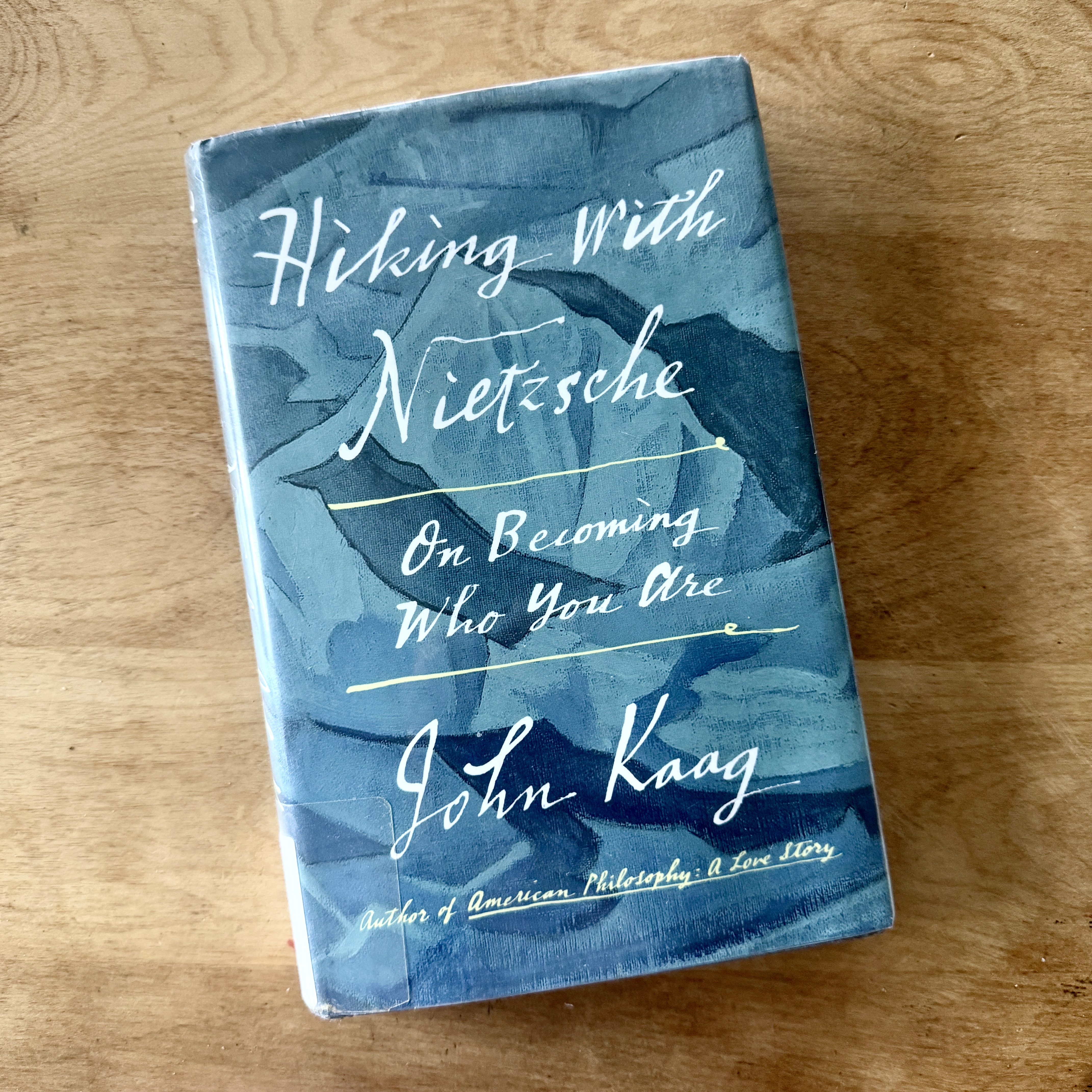
We all have Nietzsche to thank for presenting us with “Become who you are.” You know, that crippling question that makes you rethink your entire existence. Am I who I am? Or am I a product of what someone else wants me to be? Or what society wants me to be? And if I become who I really am, will I like me? Damnit, just give me Netflix and a new phone. I don’t want to work this hard. John Kaag asked himself these questions, first when he was nineteen, and again many years later. “Hiking with Nietzsche: On Becoming Who You Are,” documents Kaag’s trips to the Swiss Alps above Sils Maria, the exact same ground that allowed Nietzsche the mental space to map out who he would become while writing his most memorable works. (He eventually lost it.)
And speaking of writing, Nietzsche was a machine. He walked endlessly, wrote feverishly and was a master of self-discipline including fasting for long periods. (Fasting and walking, how many of the greats were practitioners?) Kaag struggles to match the intensity but roams freely and learns a lot about himself in the process. Philosophy is such an odd and wonderful pursuit. I equate philosophy to talking about geopolitics. My interesting friends love to ponder the possibility, knowing there are no real answers, while my not-so-interesting friends just say “I don’t want to know.”
I like this book because it provided me a much better understanding of Nietzsche while also making me want to visit this region, and the exact hotels and lodges where Mr. Nietzsche did his thing. Kaag’s writing style is smooth and blends historical context with personal adventure. I always enjoy books like this. If I had to ask Kaag for something more it would be about HIM and not Nietzsche. I love personal narratives where someone is undertaking something poignant, attempting to make sense of it all, and writing all along the way. Not easy.
Comments 10
I few years back while visiting a hospital patient, I grabbed the copy of Descarte’s ‘Meditations on First Philosophy’ I found in their bag. As the conversation ebbed, their sleepiness took over and my reading deepened, I found myself alone in my head wondering if I was even real. Good philosophy writing can do that. Still have that book and ain’t giving it back.
Author
Yes, love the idea of making us think. Really think. Alone in our thoughts. Left to wander and doubt.
An eventually fruitless journey, Dan, because none of us ever gets to know who we are. I think that’s because we are not really completely independent entities, but more just appendages to the greater scheme of things.
Those of us who attain great successes may think we do so by ourselves, which strokes the ego, provides a hero version of ourselves for home consumption and is comforting, but no, nobody does: everybody ultimately depends on someone else coming along for the ride, even if just to hold ajar a door or two. We, as that poor old oft-quoted river, are in a constant state of flux. By definition, then, we are never the same creature for more than a very short time, a state changed for us more by accident than design. How, then, can there be any definitive slot that we can refer to as our own, the marker by which we know ourselves and others can agree encapsulates the essence of who and what we are? Even the opinions that others hold of us are subject to mood, either theirs – or through our own as projected – whenever our paths cross.
I guess that what we can lay claim to is a private recognition of our weaknesses, of the lessons we never allow ourselves to learn but wilfully ignore to our repeated cost. Perhaps that understanding allows us one crumb of comfort: we have at least a shrewd idea of what may be our type.
Author
Not so sure about that Rob. To each his own. Just the idea of thinking about it makes it all worthwhile. Real thought, alone.
I’ll have to check this book out. Also, if you’d like to learn more about John Kaag, listen to the beginning of this video where he describes discovering Thoreau as a kid, and deciding he wanted to become a philosopher and teach: https://www.youtube.com/watch?v=xGAYNEOkYW8
Author
That is so great. “I’m gonna teach philosophy and live in Concord.” Boom, done.
Right now I’m reading “A Philosophy of Walking” by Frédéric Gros. It covers the greater mental, cultural and philosophical aspects of walking, and, incidentally, also contains a chapter about the importance of walking for Friedrich Nietzsche’s work. I’ve been an enthusiastic walker for all my life, and enjoyed this book a lot.
Also, considering my photography, walking is important. I sometimes read about people driving around for photography; when they saw something, they’d pull over and take the picture. This never worked for me. What looked great from the car, never worked as a picture, as far as I’m concerned.
Author
I’ve had to do quite a lot of both. Working as a press guy meant constant driving for pictures, and to assignments, but on my own prefer to walk it out.
https://leicaphilia.com/car-sick/
The above, a book by the late Tim Vanderweert who had the blog “Leicaphilia”, was shot from his car, or at most, a few yards away from it.
I have a copy, and am glad that I do. Looking at it from time to time brings back memories of a photographer/writer who managed to keep me checking out his site every day, just to see if he’d put up another photo or written something else about photography. He was one of – if not the most – articulate writers on matters photographic that I ever had the good fortune to find. A lawyer in Raleigh, photography was long his visual passion.
For myself, I have no doubt that doing it by foot is the best method of finding something to photograph, if only because you don’t have to think about whether you can stop the car without causing an incident. Thing is, on foot or seat-borne, you still have to have the eyes, that visual sense of what you think you can make the naked reality become. That’s where I think one very famous colour/art photographer falls down: the straight snap is not always the best that the world has to offer. In fact, it is often the most boring of all choices, as he usually proves.
Author
Oh ya, can’t compare car to foot travel. Especially for imagery.