

What I’m about to say will trigger some people. Too bad. I’m going to say it anyway. Once you know the work of W. Eugene Smith exists, it does a number on you because it’s nearly impossible to forget what you have seen. You could try a frontal lobotomy, but imagine if it didn’t work, or if it left you with ONLY the remembrance of what Smith accomplished. Either way, screwed. For me personally, there was life before knowing about Smith and life after.
You could choose to flee and make excuses, as many of us do. “Well, I’ve never been gifted that kind of….whatever,” but you know that’s a cop out and it certainly does not fit the narrative. Smith wasn’t spoiled, he was possessed. He also loved amphetamines and alcohol which ultimately cut his life far shorter than what could have been. He also suffered from war injuries, physical and mental, which also helped extinguish his existence. We were robbed. The cruelty of fate and misfortune.
But fortunately for all of us, Smith was a grinder, and when say “grinder” I mean all caps, three hundred point typeface. Days on end in the darkroom. Pills to keep him going. Pills to get those blacks just right. Pills to make thousands of 5×7 work prints. The work before the work, so to speak. And speaking of work, there was only the work. I’m not saying this is healthy, or that you should do what Gene did, but when it comes to full commitment to craft, that’s the upper level.
“One thing that’s not talked about often is that you kind of almost have to hide out in order to develop your craft. You have to be isolated in order to practice enough to be any good.” from “Gene Smith’s Sink” Sam Stephenson
No offense, but you shoot-and-share types or you “Three-Day,” film types should check yourself. It ain’t working. Smith would have detested what photography is today. The rock skimming of time spent in the field. The premature release of work, ruining any chance of powerful impact only achieved once the final product has been sharpened to a razor point. Smith worked on projects for YEARS. Obsessively. And these projects ranged far outside of photography.
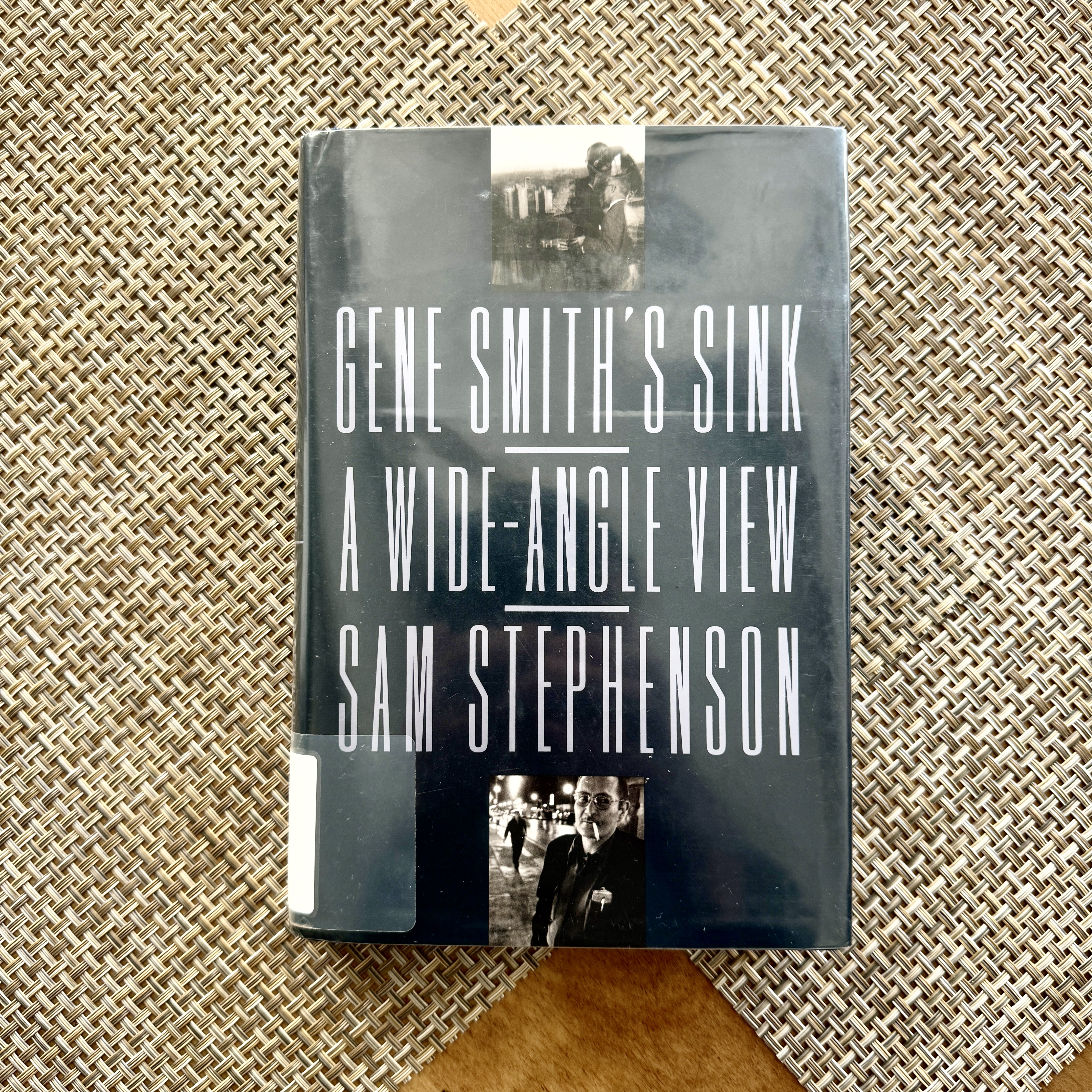
Sam Stephenson’s “Gene Smith’s Sink: A Wide-Angle View,” is an incredible book because it provides not only a history of Smith, but a history of the human planets orbiting around Smith during his most productive time. Theatre, music, and sound. Smith was as all in on these pursuits as he was with photography. Some of you might know about The Jazz Loft Project, which details the compulsion to record the underground jazz scene in the loft building where Smith lived. If he had ONLY done this project it would have qualified him for the Photography Hall of Fame. Minamata, The Country Doctor, WWII, the Spanish Civil War, Pittsburgh. Any ONE of these would mean the photographer had gained legendary status.
To accomplish them all means one thing. GOAT.
A few weeks ago, I made a film about context. This post is a continuation of that idea. Once you know about this work, how is it possible someone would waste their time on YouTube photography? I keep asking myself this, but I also know that people watch camping in blizzard films and films about people doing all kinds of stupid shit the viewer is never going to do, but they keep watching anyway. Smith had his distractions, like theatre, music, and sound but they FED the work. They made the work better. His distractions were not senseless waste of time moments happening seven days a week at all hours of the day.
And in case you were wondering or about to drop the “He must have been rich,” lunacy that so many lazy people fall back on, just know Smith was dead broke most of the time. The book includes a series of bills and overdue legal notices that Smith received during the peak of his powers. A shoestring baby, a shoestring. According to sources that assisted with his Minamata project, Smith spent the bulk of his money on alcohol and photography supplies. Food was secondary.
I know that many you, most even, have no desire to be photographers. Photography is a hobby. And I’ve said many times, that’s a great place for photography to be in your life. But some of you out there reach out to me about being more. Some of you are ready to work while others have the commercial, fame cart well out in front of the horse. Get good first. That’s my advice. Learn photography. Skip the ninety percent marketing scheme for a while and see what you are capable of.
Reading this book was a hard thing for me to do. I knew it would be bad, but I’ve turned the truth on its head.(Bad because it reminded me of how little I’ve done.) The book inspired me to shoot more, a lot more. I’ve been doing this for quite some time, so I’m not fooling myself into thinking more means better but I’m doing it anyway. Last night I left my home office to venture downtown in the late light. The plaza was deserted but the light was incredible. I photographed a man in a suit covered in buttons, a woman holding an anti-war message and a family involved in a snowball fight in front of the massive church. I also sat and wrote for over an hour. The temperature was in the high 20s. Smith would have laughed.
This work I’m doing now is part of a project, of course, a new project that came to me a few short days ago. Something I can and will work on regardless of where I am or what I’m doing. I’m four days in but feel a sense of purpose I’ve not felt in years. The book also reminded me of my love affair with jazz. I was once a frequent customer at the jazz clubs in Los Angeles, a period I had forgotten about. I once tossed all my CDs and kept only a handful all of which were all jazz classics.
Last summer I stopped in Pittsburg to make a short film about Gene Smith’s influence on me. Like most modern things, I had little time to make something. Even pondering the idea is a bit of an insult, but selfishly I wanted to do it just to be able to walk some of the same ground. For a brief moment I let myself imagine. The heavy grit in the air. That jet black seam under the city. The water to transport it away. Gene’s ghost right there with me. Get it, read it.
Comments 20
He was, without question, the photographer I admired the most all through college when I thought I wanted to be a PJ. The amount and breadth of his work is staggering. It’s a shame he lived in a time that didn’t have proper supports for guys like him. I have a book I covet that profiles different photogs and their darkrooms, made in early 80’s, and he’s in there! There was the shooting and that was one level of focus, but the darkroom needed another type of obsession. He really is the GOAT. Thanks for this review I had no idea this book existed.
Author
I don’t think we have proper support today either. Some places in Europe do a good job of supporting doc snappers, but certainly not here. And yes, he was all in.
The first time I heard the term “photo essay”, I learnt about this man. Since then, I have searched and seen all the documentaries there are, all the articles, different books surrounding this man. This man, to me, is really the Greatest of All Time. A man scarred with injuries, mental trauma, broken family, hundreds in debt, worked and worked and worked endlessly for his essays. The photos he captured, my goodness, the emotions in all of them, the eyes, the obscured faces, the ominous silhouettes. Thousands of photos. I get scared seeing his works. I feel like I am in a small boat undulating in a vast limitless ocean. Whenever I look at this man, I realize, the way every minute he was lost in his own perfection.
Thank You so so much Dan 🙂
Love from Rick Ganguli, India.
Author
He was the man. Perhaps not the best of men on a personal level but certainly when it came to his work. The Steve Jobs of photography perhaps.
I remember seeing a photo of him wounded in a hospital bed after a piece of shrapnel ripped through his cheek and hand when he was in Okinawa. No doubt he had his demons, but talk about dedication to craft.
Author
Some of his WWII images are pure insanity.
From Sam Stephenson’s website and favorite paragraph:
“When Smith died in 1978, he left behind eighteen dollars in the bank, and forty-four thousand pounds of archives. He was only 59, but he was flat worn out. His death certificate read “stroke,” but, as was said of the immortal jazzman Charlie Parker, Smith died of “everything,” from drug and alcohol benders to week-long work sessions with no sleep.” https://samstephenson.org/gene-smiths-sink/
Author
I love that quote as well. A lot of those jazz guys died horrible deaths as well. A rough life.
Loved that book, and also a jazz fan. He was as meticulous recording those jazz sessions as he was about his photography. One of a kind for sure.
Author
I met his sone once while living in California. He came and screened the Jazz Loft film. Nice guy.
Great timing for this post Dan, I watched Minamata last night! I have several books about Smith as well, he was certainly driven!!
Author
I’ve got to track that film down.
One of my greatest regrets is that my copy of Camera 35 magazine which was totally devoted to Smith’s Minamata essay disappeared during a rough period of my life. Published in the 70’s, the editors handed the layout of the magazine over to Smith and it was brilliant of course. I at least still have my memories of his exhibition at the International Center of Photography in New York in the mid 70’s. Every piece of work he did was full of emotion. Something missing from so much of the imagery today.
Author
He had some purpose behind him. And the magazines of the era, at least to some degree. But even still, he was possessed more than most.
Just ordered the book, I have always loved Smith’s work and you are so spot on, there is a before and after with him. I feel the same way about Salgado.
Author
Yes, there are a few who set the bar. Each genre has their legends.
W. Eugene Smith: “Country Doctor” for Life Magazine, 1948.
If I had possessed a camera post WW 2 and had known what I know today I would have documented my Father’s role as the country doctor.
Having returned home from witnessing the horrors of the Pacific Theatre he embarked on serving as a general practitioner in four rural counties in south Mississippi for five years. Smith’s “Country Doctor” is a mirror image of my recollection of those times. Service to mankind 24/7/365. No Medicare or Medicaid. Patients who could not pay paid in kind with food and meat they harvested.
Shoot, document and print for those who will reflect on our past.
Author
Wow, that is quite a story. I’m reading a book about a guy who lived with a street gang and it is reminding me of my time with a gang while in school. Memories etched in my mind.
Great recommendation. Loved this book! I ordered the Jim Hughes book from the library to continue my education.
Author
Jim Hughes is awesome.