
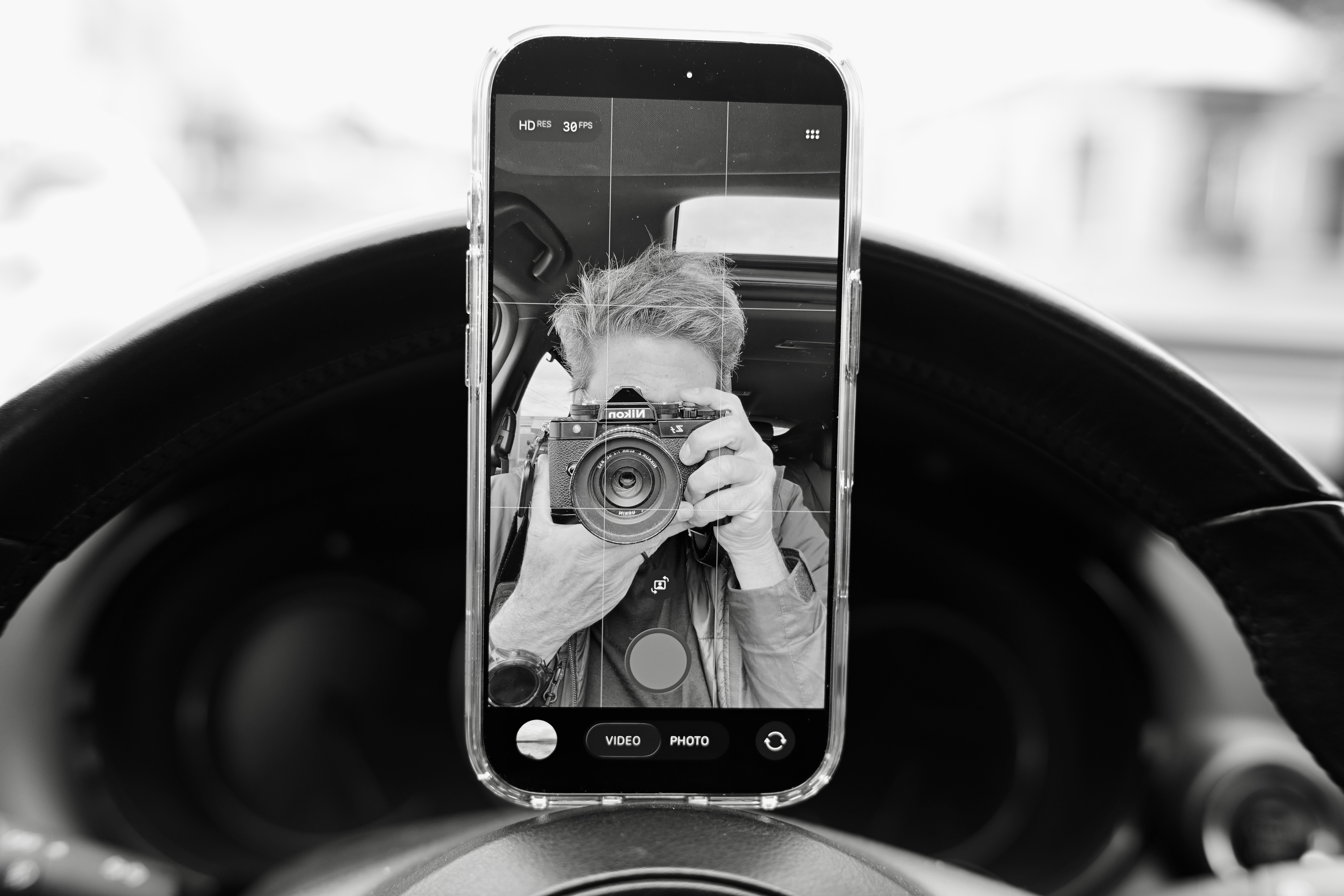
Some will tell you that the story doesn’t matter. They are wrong. Story matters. In fact, you could argue it’s the most important thing. These others will tell you story doesn’t matter, or that it’s overrated, for different reasons. One, they don’t know how to tell stories. Two, they only know random photographs. Three, they don’t want to work that hard. Often, they are more consumed by their own look and style than the photographs they create. They are consumed by groupthink. The rise and post crowd.
Stories take time, and that doesn’t feed the algorithm.
The gear-obsessed crowd is sizable but boring and rarely creates anything of note. They don’t need to. They are happy to live at the front end of the conversation. They show images and then quickly disappear into the camera and lens and their entire history of cameras and lenses while claiming “It’s not about the gear,” but for them it is ALL about the gear. They often toss out statements like, “The camera is just a tool,” while going into great detail about why they need vintage lenses to capture those random street photographs. This is a vibrant subculture that dominates much of the online photography space. They are coddled by the camera companies, rightly so, because all they want is the next model and the one after and the one after that. They are willing to buy more than one new camera per year, which triggered the digital arms race all those years ago. (US and Japan, two largest markets for photography gear.)
Above the gear-obsessed crowd is the crowd obsessed with photography in general. If you have to choose between these two groups, choose the latter. You might think this crowd is good, or harmless, and in some ways you would be right, but in others perhaps not so much. This crowd is ALL IN on photography. (A good thing.) They constantly attend shows, they buy books, and they read anything and everything they can about photography. They spend days, weeks, and months consuming YouTube content. They dominate the chats, groups, forums, and social media feeds. They talk about photography 24/7. With “talk” being the key.
But in many cases, when I meet with these folks and ask about what they are doing, what story they are trying to tell, what sense they are making of the world and their work, they are completely and utterly lost. Instead of slowing down and asking what story they are trying to tell, they will buy another book, attend another show, or talk about something they think they will do later. Moving the goalposts. They bounce from unfinished project to unfinished project.
At some point, you must stop and ask, “What story am I trying to tell?”
Those of us who have been at this for way too long know the answer to this question BEFORE we begin. The story is what triggers the photography. The experience of making the pictures becomes the most visceral aspect, then the edit, the sequence, the copy, the design, the packaging, and the print follow shortly thereafter. The conversation is NOT the photography. (This ship sailed with Instagram.) The conversation is the STORY.
Sharing stories dates to our species’ discovery of fire. Fire gave us time and protection. With time and protection came language, music, and art. Boom. Stories around the cave fire. You and I are doing the same thing today. It’s not particle physics. It’s, “Hey, did you hear about Bob getting mauled by the sabertooth?”
You need to have your own thoughts. It’s that simple. What do YOU believe? How do those beliefs make you feel? What is important to you? What happened to you? How do you translate that story to the masses, your family, yourself? If you are talented, relentless, and lucky, you might make a handful of transcendent pictures in your lifetime. Maybe. Maybe you make three or four. Total. Pictures that take a viewer’s breath away, and sear that image into their DNA. Look at the best photojournalists in history. How many life-changing pictures have they made? How many policy-changing, history-changing pictures? In many cases, the number is in the single digits. Sure, they consistently produce good work, but great is reserved for those very few, once-in-a-lifetime moments. So, what do they have left? STORY.
Philip Jones Griffiths didn’t get banned from Vietnam for walking around shooting random street photographs. (By the way, had a wonderful, multi-hour conversation with him while walking the streets of San Diego.) He got banned for telling the story of America’s failed foreign policy in Vietnam. At the time, South Vietnamese President Nguyen Van Thieu said, “There are many people I don’t want to see back in my country, but believe me, Mr. Griffiths is at the top of that list.” I was going to say I don’t know why prosumer photographers find this so difficult to grasp, but I do know why. Because the online nonsense side of photography is SO EASY. It’s always there, like fentanyl. One hit, and you are toast. One gear review video and you just lost another day of actual work.
Think of this in terms of comedy. You have one-liner comics, and then you have the absolute best comics telling stories that end in punchlines. Henny Youngman vs Dave Chappelle. They both require skill, but have different lasting impacts. One totally cracks up your parents, mine too, and other able to transcend comedy, history, social issues, cultural issues, etc., and in the process become more than a comic. That’s what we all want and need to be, more than photographers.
On my recent Patagonia trip, we met with trackers, marine biologists, guides, gauchos, estancia owners, and others who provided background on life in Southern Chile. Even though they knew I was a photographer, that was NOT the conversation we had. We talked about STORY. A marine biologist teaching indigenous peoples of Southern Chile how to reengage with aspects of their culture. An estancia owner fighting to save her horses in the face of mounting pressure from the native puma. We didn’t talk about photography. We talked about telling stories. And we sure as Hell never mentioned cameras and lenses. Good grief.
If you have never told a story with your camera, I have some advice for you. Stop watching YouTube photography channels. They will be there when you return, but most likely, you won’t want to return to these channels after you figure out what you are doing. Next, start reading and writing every day. Doesn’t have to be much. Let your mind wander. And don’t read books about photographers. Write a single line, a paragraph, whatever. Doesn’t matter what pen you use or how your desk looks while you are writing. Finally, stop random, start a theme. I would say at least seventy-five percent of all the people who ask me to look at their work only have random images. Not good enough. Find a theme and spend as much time as possible on that theme. Build a body of work. Tell a story. DO NOT SHARE YOUR WORK AS YOU GO. The fact that I have to tell people this is sad. Sharing as you go does little more than water down your work and makes you look like an insecure animal starved for attention. For those on the outside looking in, it’s embarrassing.
Take your time. Talk to people. Try new things. Don’t focus on what is in your hand. Focus on what is in front of you.
Comments 19
Stories and images in the caves, by the fire. Much before we imagine. Check this: https://youtu.be/qLoYyM_88yg?si=gqNK8Br_-08eG120
Author
Somehow I had already seen that. You might have sent it via WhatsApp? Another reason to see Brazil!
“The story is what triggers the photography.” Wise Milnor wisdom. Alys Tomlinson comes to mind. She tells beautiful stories. Publishes books, wins serious photography awards. Youtube camera enthusiasts flock to the flashy McKinnons of the world, but Tomlinson’s work represents story and craft and everything I believe you argue for here.
Author
don’t know her but will look her up. All of the photographers that influenced me started with story. They didn’t just wander around hoping for something to happen.
I needed this kick/motivation, what has mulled around in my head needs to be actioned. You encapsulated/summarized it well. Onwards and upwards, thanks Dan.
Author
Glad it helped.
If story means narrative, then photographs shot strictly for aesthetic purposes have no story, so “theme” in this case would be more accurate (and necessary, to avoid “the random”).
Author
However you want to slice it. It boils down to what story are you trying to tell?
Daniel, I started reading up on Craig Mod based on your comment to me under a recent post. Sharing as he goes seems like a key part of how he built his large membership base to support his work. That was my impression after reading a few of his posts.
What would you say it is about the way he shares that helps him avoid the pitfall you mentioned? Are you one of his members?
Craig shares as he goes during his pop-up, but has, on numerous occasions, made it clear that what he shares isn’t the final product. It’s a framework to get the groundwork for the actual work that he shares.
Author
Spot on.
Author
This requires a long reply, which I don’t have time for at the moment, but Sean has posted above and brings up a good point about how Craig shares. Most likely, he’s on IG too, or some other social network, but I don’t need to engage him there because his site is so good. Craig is a book guy. Just that alone means he’s not sharing everything as he goes, but someone else was confused by what I was trying to say, so it probably begs another post. Getting feedback along the way is good, from someone with skills, but sharing nonstop on social is what you should avoid. Most people new to photography share much too much and much to soon. They get random comments from random people and then eventually to someone like me after being completely turned inside out. I just came back from Patagonia, scouting not working on a story, but how many posts did I do while there? Zero. How many times did I post on social? None. Unless you count YT shorts, but how many images did I share? None. At least none of the final take. Those will come out in time, and in print form.
Okay, thanks Sean, Daniel.
Craig wrote that he uses Instagram (at least he did around 2024 which is when he made the article) and YouTube. I will be there to read the post if you decide this topic deserves a longer reply.
Author
You need to understand what he built, and why it is different from almost everyone else, but to understand you need to go back over twenty years when he began to lay the foundation for what he has today. He could see the long game. Most photographers can’t even seen what is right in front of them. Not to mention, what Craig has now is just the latest version of what he’s created. He’s the creator of a site called “Hi.co” a real-time writing community, which was one of the best sites and communities I’ve ever seen. Is he a photographer? Ya, but that’s not an accurate description of him. He uses photography to tell stories and make books, but he is WAY more than someone who presses the button. I realize most people(photographers in particular) are offended when they see what he has. They immediately look for holes in his work because they are jealous and frustrated they will, most likely, never be able to build what he has.
I’m happy you’re back safely from Chile and yet again imparting wise words on us all (and giving some of us a kick up the arse).
There are a dozen or so textbooks I use in the classroom that teach kids about adventures and interesting people, and nearly every introduction starts with, “This is John Smith, a photographer and marine biologist,” or “This is Katy Jones, a thermal geologist and photographer.”
I wish I’d become a volcanologist and photographer. I wonder if I’m too late? 🙂
Sean:
Sounds like a heckuva cool reading list. Care to share some of the titles?
Paul – They are textbooks for teaching English to foreign language students. I’m not sure they’re what you’re after but if you search for Cengage Learning Japan you’ll find some. They source a lot of National Geographic material.
I worked for 15 years or so as a reporter, mostly shorter magazine stuff, event coverage, and then moved into features. I almost always worked with a photographer. Now that I do different work, I’m feeling the itch to get back to telling stories, but bigger ones, and I find myself falling into the trap of never-ending planning. The reality is that I NEED to start talking with people, identify those who are willing to be subjects in the bigger story. Those conversations will be where I learn if my hunches and solo research are right. Get in the field, as you say.
I had a job covering three of the Olympica Games (starting with Vancouver) for the Canadian broadcaster. In the lead up to Vancouver, I asked one of the more well-renowned writers how he knew so much about every sport to be able to write so well about them. He said the trick was knowing you could learn what you needed to about any sport in 15 minutes with an athlete or coach. The only question that really mattered is WHY that athlete was so devoted to what they do. Knowing their story is how that story would end up being relatable for the audience.
Author
And the best photographers know the sports too. I remember doing an NFL game with a Sports Illustrated photog who never played football, but he knew the team’s playbook front to back. So at third and short inside the twenty, he KNEW the game and where they were most likely to go with the ball.