
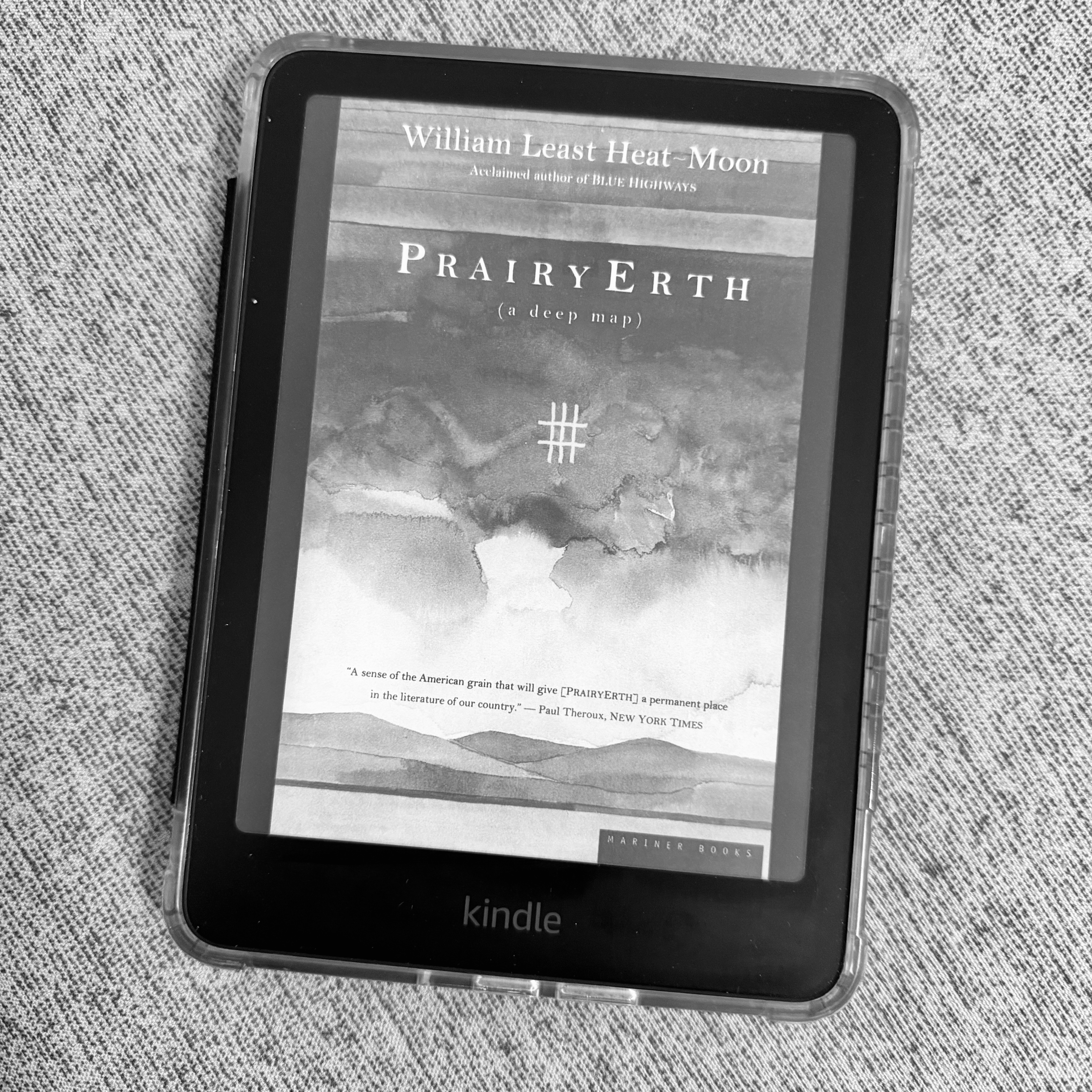
Yes, this post is about a book, but it’s coming under the “Creative” title for a reason. I don’t remember mentioning a book halfway through the reading of it, but I’m doing so now, and I’m doing it for good reason. We got off easy, and by “we” I mean photographers. I’ve always believed writing to be the high art, much more impactful than photography. I’ve said this at photography talks, Blurb talks, talk/talks, and anytime anyone asks. William Least Heat-Moon reminded me of this, once again.
I’m halfway through his 800-page book about a 774 square mile tract of land in the Flint Hills of Central Kansas.
Do I live in Kansas? No. Do I have family there? No. Have I ever been to Chase County? No. Do I know anything about this place? No. Was I asked to read this book? No. I’m reading “PrairyErth” because of “Blue Highways.” “Blue” is one of my all-time favorite books about travel in America. I learned things from this book. If you learn about America from people who live in major cities on the coast, you don’t know shit. It’s that simple. If you haven’t read “Blue,” by all means, you should. Based on my love of this book, I’m reading “PrairyErth,” which is a deep dive on the Flint Hills of Kansas.
When I say “deep dive,” I mean 800-pages. (Kindle) Heat-Moon puts in the work, and this is what this book reminded me of. We photographers, skimp on SO much. We phone it in. We act like we do research, and sometimes we do, but it’s still superficial most of the time. Just enough to make it seem like we know what we are talking about, but when pressed for intimate knowledge, most of us fall flat on our faces. I’ve found that even photographers who have published a book about a certain place often don’t know much about it. I listened to war photographers who act all concerned about their subject, but don’t know much of anything about the people, the place, the history, the theatre. Nada, nothing. Just there for the prizes, thank you. Just there for likes and the ability to wear a scarf at the party in 90-degree weather.
You can FEEL the time “in country,” or in this case, “in county,” with Heat-Moon. The quotes at the chapter heads alone are enough to make one dizzy. Dozens and dozens of quotes about specifics of place. You could fill your reading list for the next ten years just by choosing books from here. If he’s read half of these books, he’s done more research for this ONE project than I’ve done in my lifetime, and that is no exaggeration. You add his personal experience, extensive historical research, and the interviews, and you have yourself a Kansas-style opus.
I’ve spoken about this many times before, but it begs to be mentioned again. Our pace is messed up. We expect now, and we expect instantly. We demand relevance, notoriety, fame, without putting in any of the work. Kids choose their gallery and book publisher before making any of the images. Photographers shoot for two days and call it a “long-term project,” then look for a show. We post nonstop nonsense, then stand around waiting for likes. If insufficient likes arrive, well, take it down because it will disrupt “the flow.” Jesus fu%$ing Christ.
An author can’t hide, especially one writing nonfiction. What, you gonna write ten pages and call it good? That one paragraph you mustered for your photobook ain’t gonna cut it, and yes, I know it’s a photography book, but it still needs copy, no matter what you tell me. There is no hiding from it. I’ve heard every excuse in the book. “I want my photography to speak for itself.” Copout. “I was going to research my story, but I didn’t want anything to influence my vision.” Oh good God, copout. Make photo things for other photo people; sure, you can get away with anything. Write a wishy washy artist statement, act tough, ignore the past, history, and influence, beg for following, ask strangers for money, hide your shame, and heck, you are on your way. NOT GOOD ENOUGH.
And let me remind you, I’m guilty too. I’m no informational saint. Far from it. I’ve cheated, too. I’ve half-assed it, phoned it in, shortchanged the story and the people in it. I remember doing a story on people who had dropped out of society and lived in the Superstition Mountains. There was a guy with a string of pack mules still mining for gold. There was a woman and her two feral kids hiding from an abusive husband. They got their water from an abandoned mine shaft. The water looked like iced tea. The kids hadn’t had a bath or a haircut in a year. They looked like Emil Minty in The Road Warrior. And then there was “Sky Woman,” who told me she could speak to animals and that someone had been shooting at her, trying to kill her, for the past year.
I remember thinking, “Ya, ya, whatever.” “This story is pure gold, so just let me make a few snaps and get out of here.” “The paper is going to love this.” Well, guess what? She kinda could speak to animals, and the guy trying to kill her turned out to be a local sheriff. Ya, I screwed that up, big time. I tried to jump the line. I put the focus on me and my photographs, and I forgot about a few little details, namely the story and the people in it. And this is what I see happening again now, but the pace has ratcheted up exponentially. A visual narcissism beyond pale. So, I’m here to thank William. Thank you, sir. I’m a dolt. I knew it, but I needed another reminder. What happened to “take your time, do it right?” That got thrown out with the “fake it till you make it” bullshit we now celebrate. Think you got your shit wired? Maybe you do, but read something like this and then come back to me. It was clear to me ten pages in: I’ve got work to do.
You could look at this in several ways. Yes, we are photographers, not writers, or you could say, “Okay, I’m still going to ride into the sunset with my imagery, but I’ve simply got to step up my game when it comes to fully telling the story I intend to tell.” Me, I’m all over the latter. This doesn’t mean every single thing you shoot must be researched and exhausted. A workshop, for example, is a chance to explore. Workshops aren’t meant to exhaust a subject. Going out on a daily snapfest, nope, doesn’t need a full court press. But when we step to the line to produce a project, yes, this is when we need to lean into the knowledge our word-based brothers and sisters bring to the table.
At one point, the author travels to the local high school and asks the principal if he could interview a half dozen students. Just that chapter, and the insights the students provide, is so far beyond the scope of most of the photography projects I see. Reading this chapter left me feeling like I’ve spent my entire life leaving the bulk of my work on the table. I’ve not yet begun to do what I’m supposed to be doing. Oddly enough, this is a good feeling. Yes, I feel like an idiot in some ways, but I find feelings like these incredibly inspiring, motivational, and encouraging.

Little-known fact: I’ve worked on a long-term project in Kansas. I did. One small town in particular. Within five minutes of entering the town, I stopped to photograph a man watering his lawn. Turned out he was the mayor, and ten minutes later we were having lunch together. I spent days in this town. The people opened their doors and lives to me, but I never even scratched the surface. Not even close. And I never did ANY research into the surrounding area. I did choose this town for specific reasons, but Heat-Moon showed me how novice, juvenile even, my project really was. I’m not sure I’ll ever have time to do a real project, but just thinking about the possibility, and the residue of this book, remind me that I need to do better. I owe it to the story.
PS: When I undertook this Kansas project, I was at a time in my career when I thought film was the ONLY way, and that medium format was WAY cooler than 35mm for doing doc work. All delusion. After working on this project for over a year, I realized film was the wrong choice, and so was medium format. I needed to start over with a digital camera and really get to work.
Comments 6
Found both books at the local library… going to start “Blue Highways” when available and after I finish “Beaks, Bones and Bird Songs”… 🙂
Thanks for calling out the titles…
Author
Enjoy!
Another book you might enjoy is “River” by Esther Kinsky. It basically contains her observations from several walks around river Lea next to London and is written in a field notes or journal-like style. The content ranges from observations of plants, wildlife and the area in general to conversations with locals. So it’s more about close observation and reflection than actual research. The book also contains some photographs by the author, but I can’t speak about them as I’ve got the ebook version.
Author
Sounds right up my alley.
Thanks for this Dan. I have heard the authors name before, but haven’t read anything. I’m intrigued by The water Horse. I think it’s quite simple to load up a car and point it someplace. Crossing the country via a series of navigable waterways on the other hand sounds like a potential nightmare.
I learned recently that the town I was born in no longer has any significant industry of its own and is now billed as a “commuter” town for a couple of nearby larger towns. I’m sure this happens all over the place yet I hadn’t really thought about it.
Author
Yes, my wife’s hometown is now a suburb of Boston, houses tripling in price, and filled with commuters.