

I think the term “visual storytelling” is overused, but who am I kidding? I’m still using phrases from the 1980s, by far the best decade to grow up in, and yes, I still have a Miami Vice-inspired pastel suit. Having said this, visual storytelling is a key element of bookmaking, with “story” being the single most important word.
Read most any book about the origins of historically significant companies, corporations of note, or influential individuals, and buried inside that narrative will be three important words: Story is king. A book of forty nice images might be a great portfolio, but it might not tell a story, and much of the time, buyers want a narrative.
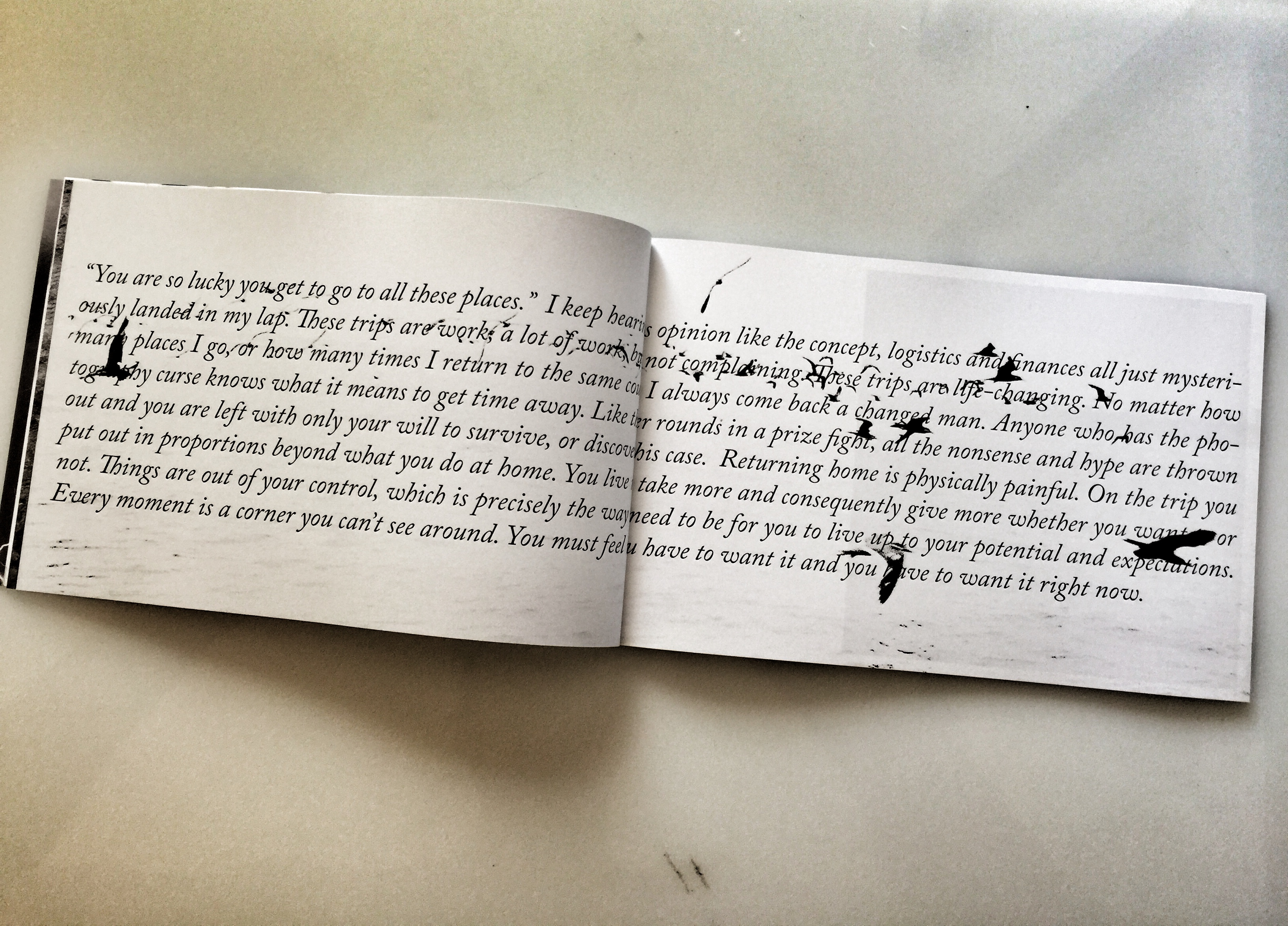
Delivering a narrative requires a tight edit, a savvy sequence, and the elimination of anything non-essential to the story. On a recent project, I made over a thousand images, but I edited that number to eleven for my final publication. Eliminating elements meant I ended up with a more cohesive publication, which I find much easier to describe and to sell if that is the goal.
Comments 15
I understand the logic of photographs to illustrate a story. Like most magazines used to be; National Geographic, The Sunday Times Magazine (London & New York) etc. But I’ve often never understood the sequencing of photographs in a photography book. This is more than likely a blindness specific to myself. However, assuming it is not, I fail to understand this sequencing idea where one picture follows another, without copy. It seems to me, this requires the editor to find something in the following picture that is also in the previous picture. It is often a colour connection or a stripe or multiple stripes. It is quite frequently a very thin link. I have quite a stack of photography books, most of them will demonstrate some sort of linking picture to picture, page to page. There is no story being told, we’re not turning the page to acquire more knowledge, just a totally different picture, probably shot in a different city or country but it has a yellow wall and the previous picture has a yellow door. I don’t get the significance of this ‘sequencing.’ The fact something is yellow in the picture I looked at before is insignificant to me. Question is: Am I a photo book dyslexic? I see photographers printing off their maquettes, laying them on a table and shuffling them around, trying to match something to another. When I leaf through a photography book, I’m absorbing the picture I’m looking at and don’t care if the next picture has three people in a triangle shape a little like the one before. Is there a workshop to educate my failure to see the significance?
Good question! I have taken lots of photos of my subject, honestly without much thought as to any sort of story or unifying concept, other than finding the location/industry visually interesting, and then finding the subject interesting as I learned more about it. Working on my photobook (for several years now), and I started off organizing the photos so they followed in some sort of visual order, but found they need to be rearranged in a subject/location order, like a journey around the location, while still keeping some of the pairs and sequences. This makes more sense when adding the written bits. I guess if you don’t have much in the way of written content, a visual order is needed to move things along. I find a visual connection pleasing, especially when it moves the eye across the spread. I also enjoy looking for the connections between photos in a spread. I remember seeing one book where there was a ball on each page, and you could follow the ball’s path through the book, like a puzzle. I’m not so good at the written part of the storytelling, as my style tends to “instruction manual”, so I tend to lean more heavily on the visual, and made my way through school by using illustrated title pages, and plenty of diagrams and drawings. I am interested in the answer to your question.
Author
Yes, and you are working it out. That’s how it begins. Start moving pieces around the board until you find what works.
“This is more than likely a blindness specific to myself. (your not alone) However, assuming it is not, ”
” There is no story being told, we’re not turning the page to acquire more knowledge, ” 👍 If your looking for this, Watch a dock-O on a Movie channel.
A Photograph, stands alone, if its to be considered, A Photograph Great ! if the viewer can’t *see IT* then a 1000 words to explained it, is a waste of paper, that could be used for more photographs.
Author
Yes, I think you might be a one-off. The sequencing is hugely important, especially in books with a narrative. This is why we have full-time book editors who do nothing else. One image off in a sequence can kill a book before it starts. I know because I made this mistake. If you have an artist-driven book that serves as more of a portfolio, sure, you can get away with anything, but story-driven books need to be sequenced. There are plenty of book workshops out there. Elena and I spend a lot of time on this when we teach, and my Hong Kong workshop from earlier this year was all about this.
One of the best examples of visual storytelling is “American Geography” by Matt Black.
Yes, Matt Black is indeed a great example of pictures telling a story. But what’s the difference between photojournalism and visual storytelling? Never heard the term when genuine photojournalism existed . Not a trick question, a genuine desire to know if there is any difference. It may be visual storytelling is only using images; can also be attributed to video/moving pictures.
Author
Photojournalism has a news angle and a deadline. Visual storytelling can cover anything regardless of news or deadlines. Never forget the “journalism” portion of the word.
Author
I like that book, but there are many, many others.
In response to Neil above, I would love an example, but if we’re in monograph territory, I think consistency in image size, mood and theme are to be expected. I am positive there has been some type of dialogue between the photographer and whomever the team was at the publisher regarding the sequencing and the image size in realtion to the pages. Whether they all arrived at a sequence that is pleasing or not is in the eye of the beholder. I’m curious if you have a book in your collection that you find to have a truly disjointed or displeasing order? Without a story or some text to inform the viewer, it may well be something as benign as a single color occurring to tie everything together. I don’t think you’re missing anything, I think the thread can be pretty thin sometimes. If you still enjoy the book does a feeble premise matter?
Whether you enjoy the work of Alec Soth or not, he has some interesting videos regarding photography books.
Author
Ha, that is an understatement of “some type of dialogue between the photographer and whoever the team was at the publisher.” Yes, try about 18 months’ worth of conversation. I was just with a book editor who just finished the 5th attempt at sequencing her latest books. Acquisition editor, book editor, copy editor, outside photo editor, book designer, etc. I just had dinner with a publisher who told me, “If someone wants to do a book now, they need to come with $35,000-$75,000.”
I have made a four photobooks in the past 12 months – inspired by this home base and it’s community comments, the youtube films and that black and white talking person. I never thought of sequencing before but it has been something I enjoyed learning about – on the Blurb youtube videos. I feel like the project is only ready when the chapter order feels right to me and that I can explain it – I like including spaces that breathe, and some quotes or narrative. One photobook was a surf photography project of ten years of photography – and the images were grouped by beach and in chronological order, another book was a 12 month project of my Mum’s blossoming garden across the seasons – and the images were ordered as if wandering through the garden, as you walk from the letter box, across the front lawn, down the drive and across the backyard, and an Amalfi photobook with images in order of towns/beaches west to east – Capri to Maiori.
Author
There you go. You are doing it. Sequencing is the forgotten child at the family reunion. Everyone seems to know about making the best work possible, then making the best edit possible, but the sequence often gets overlooked. I see a lot of navel-gazing art books designed for other photographers, where the photographer spent tons of money on the object, but forgot to make decent work. These type books don’t really need any magical sequencing, but most other books do.
Oof. I knew there was quite a cost (and a platoon of people) involved, but I had no idea regarding up front costs. I can only guess that the cash outlay for a repeat, well sold photographer might be a bit less. The art/photography publishing world doesn’t hand out advances do they?
Author
They do, very, very, very rarely. I know ONE person who got an advance in the past few years, and he had a long-established relationship. I know one other person who didn’t have to pay up front, but everyone else, globally was pay-for-play.