

Technically, the film I was using was stolen. Not by me, but stolen none the less. The perpetrator, a good friend, stole it for me because he knew I was broke, and he knew I didn’t want to fly to Southeast Asia lacking in basic needs. Malaria pills, passport and a healthy dose of Fuji RDP. (The best 100-speed transparency ever made, and I don’t mean Provia.)
My excuse for accepting stolen goods, “The end justifies the means.”
In 1996, I was still green as a working photographer. I had a degree in photojournalism and had been working and shooting daily for over three years, but I still had no real idea what I was doing. Eighteen months of daily newspaper work and magazine freelance were having a positive impact, but mentally I was still finding my way.
Like a good, young photojournalist, I was enamored by war. Not necessarily active, ongoing wars, but certainly the wars of the past. Vietnam, El Salvador, Nicaragua. I picked up a camera because of Larry Burrow’s “Yankee Popa 13.” I was mostly gutless and would never enter a war zone on my own, but I thought about it constantly.
Cambodia (my book fail) wasn’t an active war, at least in places like Phnom Penh, but it was still a place where things could go sideways in a hurry. My first night in the city happened to coincide with the end of the Water Festival. An endless sea of people huddled along the banks of the Tonle Sap as boat racers paddled till their hearts burst. And then something went terribly wrong. Rumor had it someone threw a grenade and I watched as a million people flinched simultaneously. And then they ran. As did I. Aimlessly and in a panic through the coal-black streets of a city with no artificial light.
My contact was running too, just in another direction.
I had no phone, no map, no address and my bags were in a car owned by someone I didn’t know. I walked the streets for several hours, forming a half-ass plan in my head while searching for places to sleep amid the ruins of France’s post colonial dream. I was glad for my malaria pills because the mosquitos were professional in size. The problem was the pills were in my bag. Whereabouts unknown.
Suddenly, there was my contact standing in the horribly lit front lobby of a decrepit looking hotel. He was jovially speaking with a guy holding a Chinese knockoff AK-47. All the pieces of my Cambodia puzzle slowly began to reshape. All was well. We even found a giant bag of marijuana concealed behind the non-functional refrigerator in the room. Later that night, the man in the lobby let loose with his AK, but the intended target was unclear. I was too tired to care.
By this time, I was carrying Canon EOS gear. Two bodies. One with short zoom, one with a long zoom. This was standard operating procedure for photojournalists at the time. Back-button, legit autofocus, and sharp, 2.8 zooms had rocketed Canon to the top of the professional game. But I was also carrying a Leica M4P and 28mm. This trip would prove to be a pivotal moment in my career, for many reasons, gear included.
I was there to complete an assignment, but I also had ample time to explore and shoot on my own. Phnom Penh was so raw and so exotic. Cambodia was still coming out of the long-term impact of being the most expensive United Nations Peace mission of all time. Like many other missions, things had not gone to plan.
Walking along the river in the middle of the day, I heard someone calling out. I turned to face a boy, roughly twelve, holding his own knockoff AK-47, only his was pointed at me. All around us people went about their day. The boy demanded the equivalent of a dollar. My cameras dangled off my shoulders as I slowly dug the money out from my sweat soaked jeans. The demand was totally reasonable, and it felt more strategic than fighting it out with an armed twelve-year-old. The big cameras, although capable of a wide range of photograph, were also a beacon for attention.
The next morning I woke up early, left my Canon’s behind and ventured out with only the Leica. This was the first real commitment to the rangefinder, a camera that demands constant use to reach the level of familiarity required. An extremely limited camera compared to the Canons, but one that was built for the very kind of photograph I was looking for. Close, personal, one-off.
I worked for the day with only the Leica. I felt unencumbered. I kept reaching down for cameras hanging off my shoulders only to find they weren’t there. I was slow and sloppy, but after a few hours of constant searching I was beginning to feel in the flow. I stopped at an open air meat market. I hit a temple or two. I worked street corners and monks and elephants and soldiers roaming the streets. And nobody paid any attention.
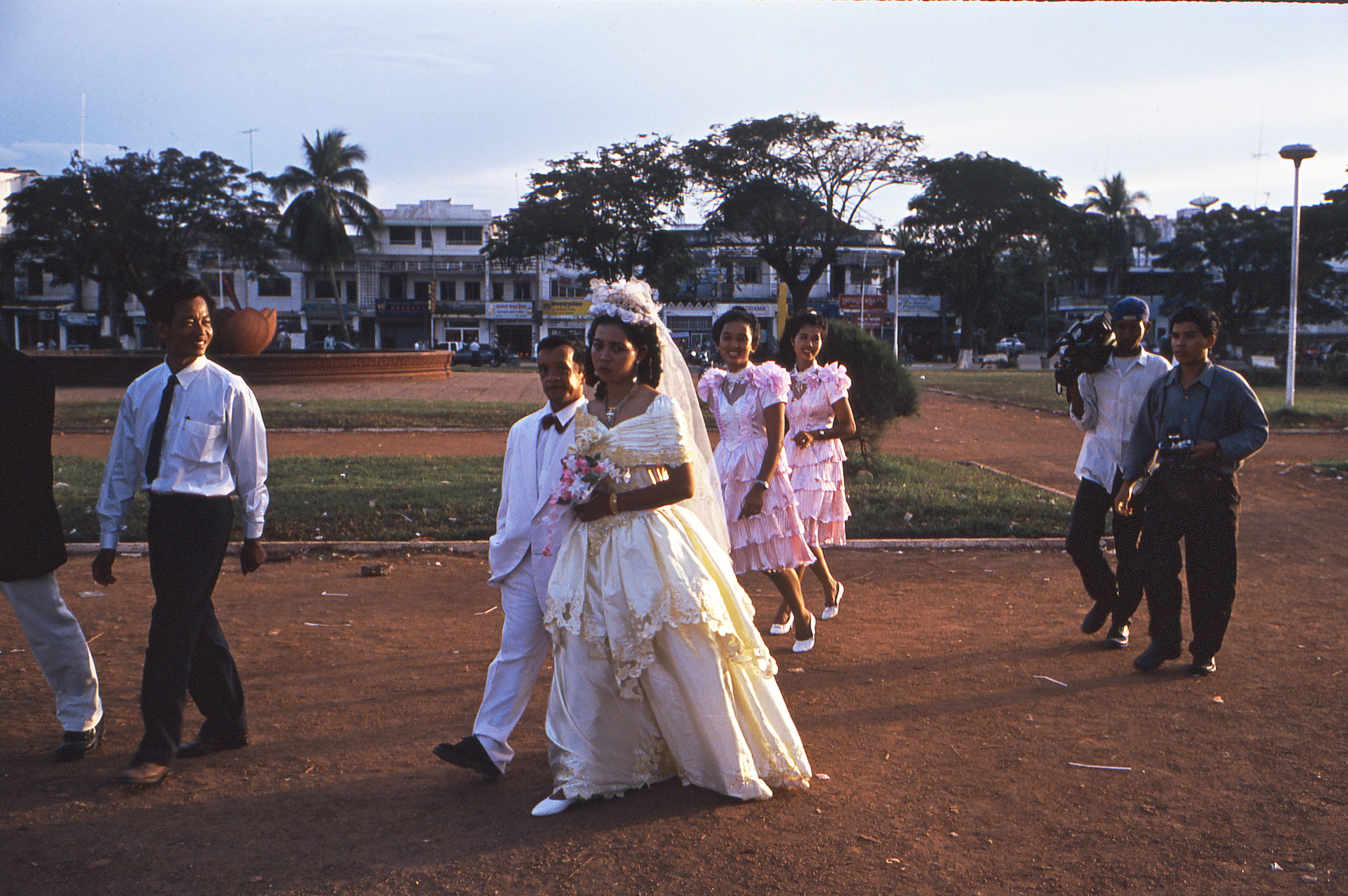
Late in the afternoon I found a wedding photography shoot. Bride and groom, photographer and a few friends and family. The light was good, the color was good and there were moments to be had. I only had a 28mm, so I had to be on top of people to make the pictures I wanted, but with the small camera it felt-semi-effortless.
As I made the picture included here, I felt a bizarre connection with the bride and groom. I could see and feel their thoughts and emotions, and I also knew they realized I was making images. I was invading their space but they never baulked. Even though I was in Cambodia, a land far different than my own, some of the exact same, normal, routine life events were happening. Life, death, marriage, divorce, graduation, incarceration. All of it. The same the world over.
The trip made me realize what I needed most was time and freedom. Two things that would elude me over the course of my entire career. I didn’t quite know it, but 1996 was the beginning of the end of the professional industry of old. Life and career changing technology would arrive the following year and there was no going back.
Speaking of not going back. I never returned to Cambodia. I missed my chance. Now I hear stories of amusement parks, massive crowds and social media based hippy guru retreats. I can’t imagine. I will miss moments like returning home from a United Nations event in the middle of the night and encountering several armed men heading in our direction. My contact yelling “Run!” as we zig zagged through a park to get away. I will miss returning to the hotel, soaked in sweat, heart pumping but laughing hysterically at the absurdity of it all as the AK man in the lobby took up a defensive position.
Photographic memories are different from regular memories, more seared perhaps. The viewfinder can act as a buffer but it can also act as a tractor beam. Even with thrusters on full reverse, there is no undoing what the shutter fused to our brain. That tiny rectangle including and excluding not just the world but our personal, individual take on it. We hope our images translate this connection, and sometimes they do. But this is a selfish game, and maybe that’s the way it should be.
Comments 19
Dan what movie is this from? I can see Francis Ford Coppola yelling CUT!! THATS A TAKE….Well done as usual Dan. You’re an amazing talent but just won’t acknowledge it.
Author
It’s a movie about a failed photojournalist. Starring me.
Beautiful piece of writing. Maybe you should consider writing only, and leave photography aside for a few months, just to see if you miss it enough to care. You, as author, are quite distinct from you as on-camera voice. Close, but I see a different personality come through.
Author
I started as a writer. But that was 35 years ago. I absolutely love to write and consider it the high art, but photography is engrained in my tiny brain. I’m hopeless. But I do like the single image with story. I’ve got probably 50 images from Cambodia alone.
Man you weren’t there long after the Paris Peace accords! Must have been fascinating, albeit a bit dangerous!
Author
It was pure awesome.
Sorry, Paris Peace agreements.
You should redesign that Cambodia book with a blurb book
I might still have the scans on a Zip drive!
Author
Already have. One of my first Blurb books, and I did a terrible job. If you follow that link you can see it.
Thanks that is a nice story and a great format. i enjoied reading that even if i knew the whole story from the podcasts.
btw is there a way to login or so on the website so that comenting is easier and i dont have to fill in my details all the time
Author
Good question. I’ll have to figure that out..
Author
if he has a WordPress or Facebook account, he can sign on in your comments and as long as he’s signed in — don’t clear cache on browser etc — he will be able to comment without needing to fill in details.
I shall enjoy reading more of your writing now that you’re pulling back from YT. Love this.
Author
Thanks Tim!
Thank you particularly for the links provided!
Seeing Burrows pictures with Farley and Magel again and re-reading the story of those men and times chills me to my bones and reminds me again of what photo journalism is and should be about.
With that said, in no way I’m neglecting the fact that tragedies and trauma of the same scale happened and were experienced on the NV side with hearts broken and souls crushed. Just without the level of published photographic and journalistic coverage.
Author
It was war. Great for business, bad for people. On both sides.
Author
Man, those Life links are insanely good!
Pingback: Creative: Documentary and Street Photography – Shifter