

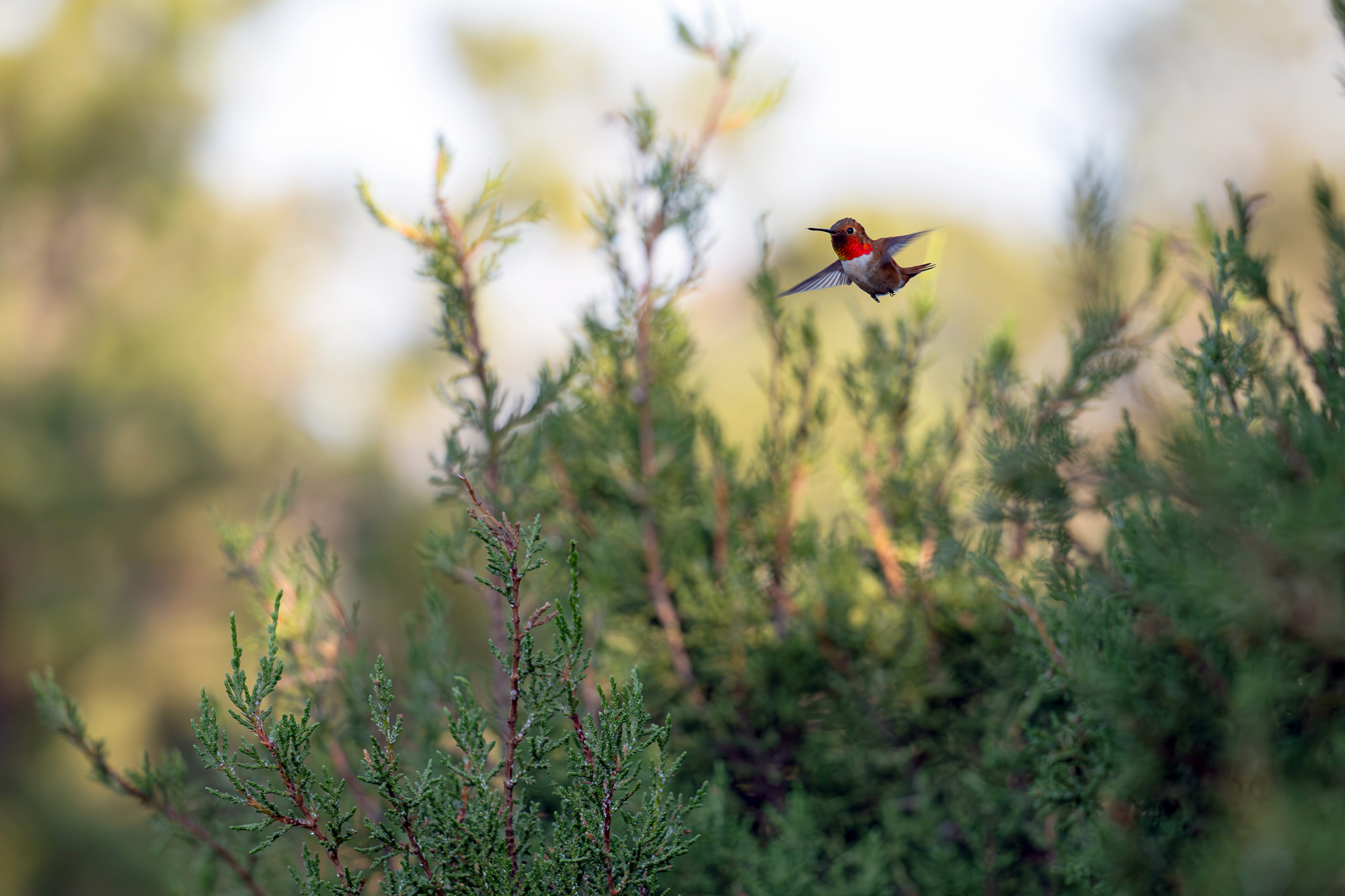
They say that everyone has a gateway bird. The bird that broke the camel’s back, so-to-speak. The bird that finally made you start paying attention. My gateway bird was the Woodhouse’s Scrub-Jay, but that doesn’t mean these crafty little sh%$# are my favorite bird. I’m not sure I have a favorite bird, but there is one avian character that has certainly made an impression on me. Meet Mr. Rufous. The baddest, most beautiful little tyrant I’ve ever seen. (There is a chance this is an Allen’s but I never know for sure.)
My relationship with this bird dates back to 1977. Rural Wyoming.
A mother who loved birds and a mother who loved hummingbird feeders. We lived far from any town and surrounded by a vibrant and semi-healthy natural world. Deer, elk, bear, mountain line, ferret, badger, beaver, and much more. And when it came to birds, there were many. Eagles, hawks, owls and numerous other species, including hummingbirds. Early in our settlement, my mother decided to place a hummingbird feeder on the front porch of our hand built log cabin. Little did she know the chaos that would ensue.
Once the tiny creatures discovered the feeder they would proceed to drink it dry in a matter of hours. This forced my mother to refill the feeder multiple times during a single day. At times we would have twenty or more feathered rockets fighter over the sugary mix. Sitting on the front porch felt dangerous as the birds would zing by inches from your face, duking it out and fighting for dominance. It was exceptionally dangerous to wear anything red.
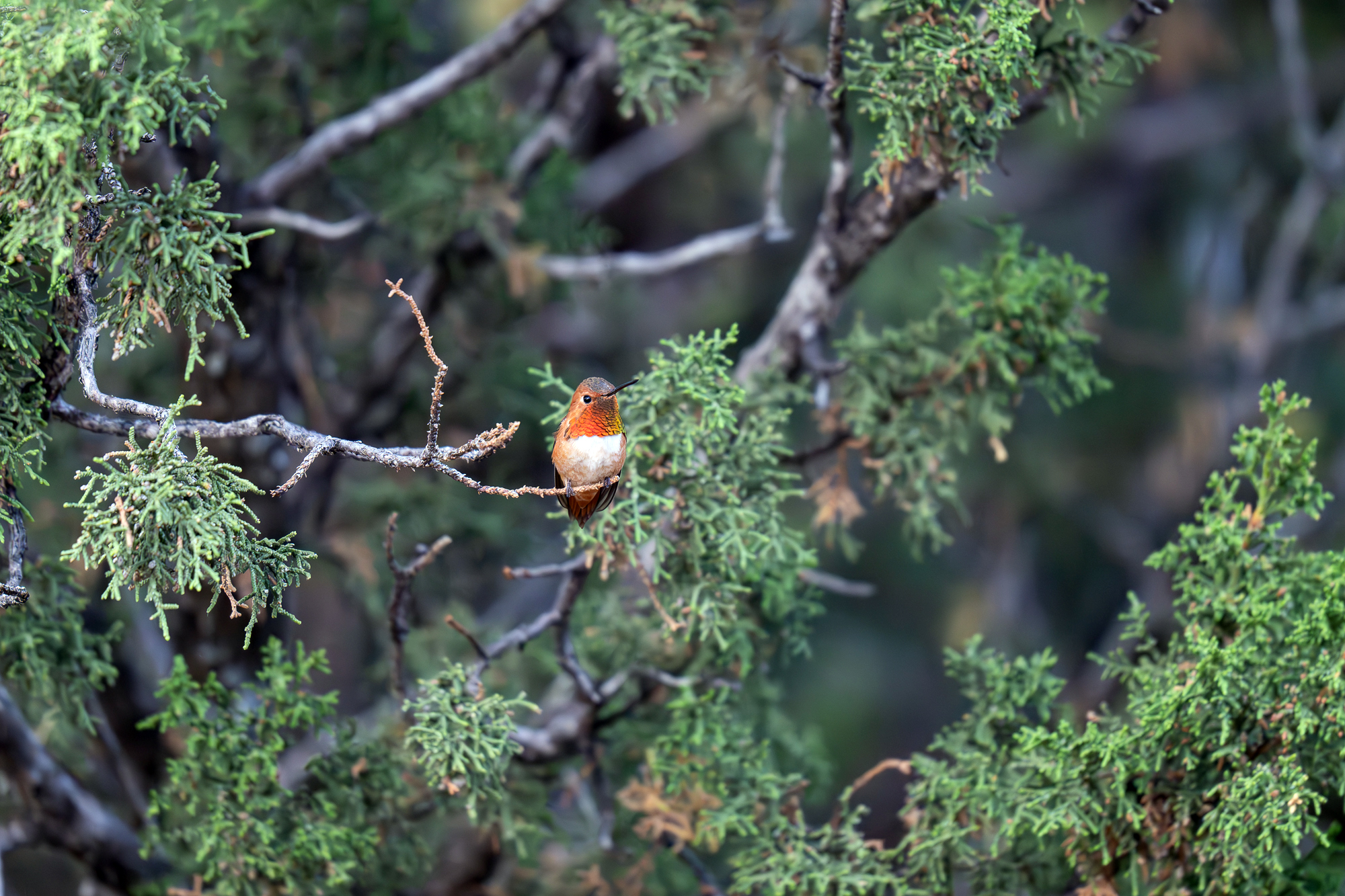
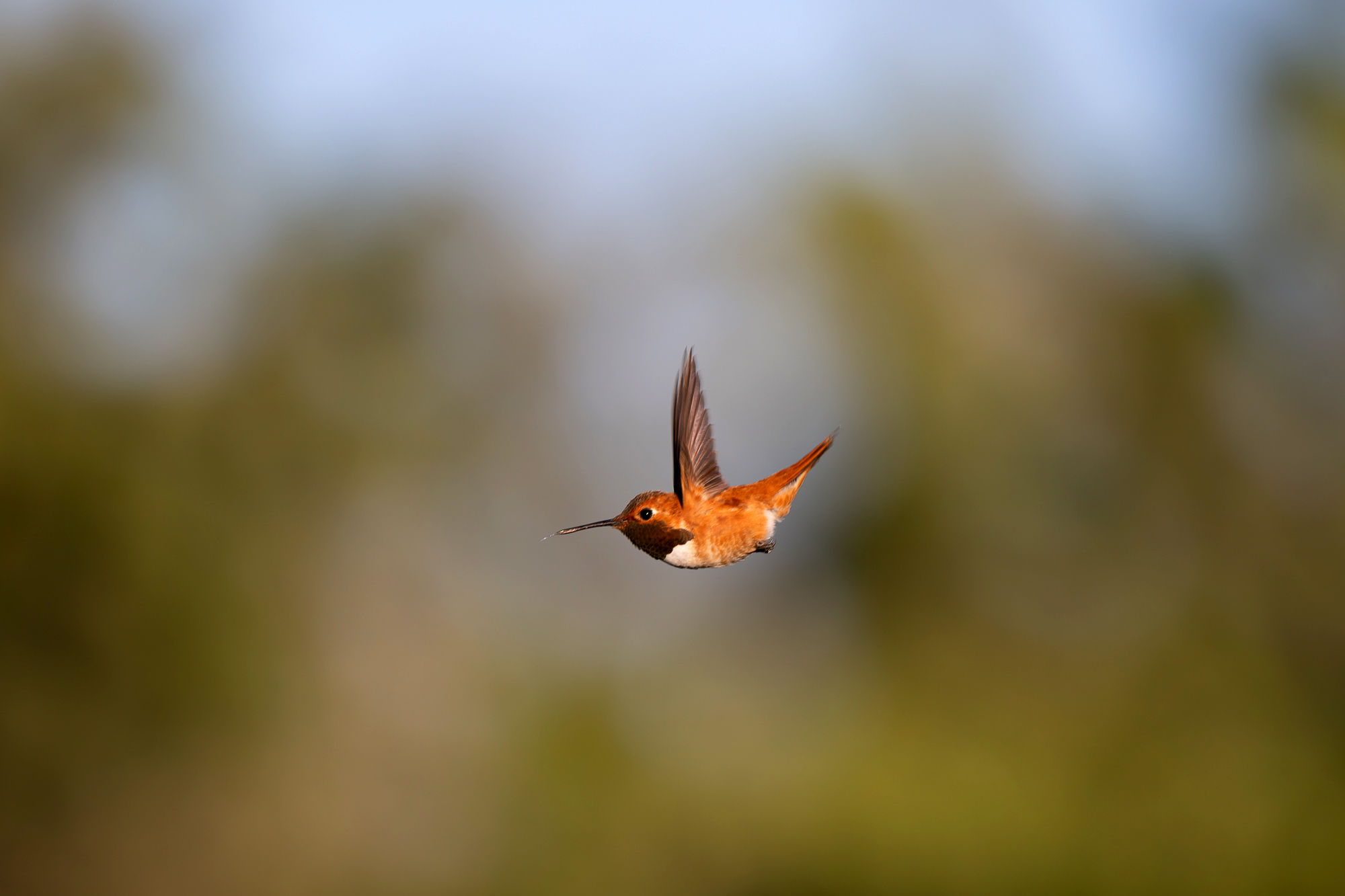
Several weeks after the birds discovered the feeder the first Rufous made an appearance. And from the first moment, we knew there was a new sheriff in town. The Rufous was a terminator. Within minutes the little copper bastards had taken over. What I found fascinating was the Rufous rarely drank from the feeder. It was as if its primary goal was to make sure nobody else got anything. Mine. Like my sister when she got a birthday cake. But the Rufous was beautiful. The most vibrant copper sheen. Patches of black and coal dark eyes. Tails flared, raging at the world.
These images were made here in New Mexico. Off my patio to be exact. I had months of harmony and then one day the Rufous arrived. I was alerted by the screams of the other species. The Anna’s, Broadbills and Black-Chinned, all forced into subservience. These other species did attempt to work in tandem, to distract the male Rufous, but the female-while slight-was just as pissed off as the male. Neither was happy with me either. They each buzzed me a few times to see if I would depart, but I said “I bought the sugar you ungrateful little jerks” and they have since left me alone. (I didn’t mean it.)
I can’t tell you how watching these creatures make me feel. It reminds me of how silly much of my life really is. How I give importance to unimportant things. How I waste time, and how I take so much for granted. These little birds remind me to just sit and watch. Listen and learn. Try to observe the small gestures and movements, and understand how fickle and short our lives truly are.
Comments 19
Gateway bird was Northern Flicker-red shafted. 20years ago I wondered what was pecking on the metal roof vents of the house next door at dawn- essentially a too early alarm clock. When I discovered how cool they were I forgave them and started bird watching.
There is a great OPB documentary on how Anna’s create their chirp when dive bombing to protect their territory/ during mating.
‘Anna’s Hummingbirds Attract Mates with Speed’
Author
I love the Northern Flicker. Gorgeous bird and very difficult to photograph.
I have a ruby throated humming bird that thinks he’s the king. He wants all the other hummingbirds to starve. He’s the only one that matters in his little mind. I’ve been planning out a blog post about humming birds as well. Lots of memories with my parents involving hummingbirds.
Author
That’s so interesting because they are low on the power scale here at my house.
Robins- The neighbour’s cat killed the parent birds, so my Mum and Dad brought the 2 little surviving robins inside. My mum chopped up worms for them, and we fed them every 20 minutes. Our pet budgie was fascinated by their gaping mouths whenever she landed on their box, but she was no help in feeding them. I remember piling in the station wagon with my family and my grandparents, a cardboard box with robins and a dish full of worms and dirt, and crossing the border for a day trip to Bellingham that summer. Teaching them to fly was fun- whizzing a baby robin through the air on your finger while their little wings were out and flapping. The robins graduated to finding worms in the compost box, and they flew away each day and returned at night. One day in the fall they both flew away. The next spring, one of them flew into the yard and landed on my Dad’s shoulder, then took off again. I love the sound of robins chirping in the forest, their song echoing off the trees.
Author
Holy cow, that is such a cool story. I saved a baby Woodhouse, and it came back to see me the next year. Hopped right up to me.
…….” I can’t tell you how watching these creatures make me feel. It reminds me of how silly much of my life really is. How I give importance to unimportant things. How I waste time, and how I take so much for granted.”
So very true, and so poignant during Covid lockdown. I remember sitting in my small south London garden; no planes minutes from LHR, very little traffic sounds, relative silence… And the birds. I felt substantially subservient to the Robins, chaffinches, sparrows who flit around me. They seemed curious as to why the humans had ‘shut down.’ I then realised how futile so much of our lives really are and how simple life should actually be. Strip away all the crap and one is left with clarity. I did feel the birds actually felt sorry for me. I could almost hear them thinking…’ you humans, you’re so damn complicated.’
The problem with humans is this belief that life is totally about “progress” in all its forms.
I can’t help thinking about my own youth during the Fifties, and how there seemed to be full employment for all who wanted to work. Pick a career: it was there for you to enter. There existed no Internet, no so-called social media, and nobody felt deprived not having either. Today, we do not have full employment, instead we have lots of jobs that are beyond the educational and mental capacity of many to attain. Of course, we also have the professional unemployed, working hard at farming every possible freebie that the state can offer.
It amazes me that folks can’t see that we are AI-ing ourselves out of any reason for existing: we no longer need trained people to put cars together so that they last longer than the delivery mileage; city stores that were hubs of shopping and social activity, where people could actually see what they were thinking of buying, or just see something that took their fancy that they would buy on impulse (some larger department stores provided coffee salons and dining halls, too, where shoppers could meet and enjoy lunch together as in ladies who) have vanished, leaving ghost centres and dead streets where shuttered doors greet people walking past. In return, we get online shopping, where people buy expecting to be able to return anything they don’t really want. I’m reliably informed that some women order four or five dresses, expecting to keep two, returning the unwanted: that all implies the hassle of posting stuff back, negating the imaginary value of online convenience. As with all those returned cameras, who then ends up buying what’s essentially used goods? It seems even worse in America, where entire shopping developments are apparently given over to dust, vandalism and crazy driving exercises. We are delighting in mass suicide.
In a nutshell, we have forgotten reality, that all endeavours require an existing market if they are to have a chance of succeeding; it escapes the notice of governments that the more they allow uncontrolled “progress” without paying heed to the social cost of ending jobs, of terminating entire genres of labour, the fewer the people who are going to be able to remain in work and provide the tax revenue that supports everything else in society. Governments have no money of their own: they can only spend/waste money that they claw from people in work or from the savings and investments of those who once did work. As I see it, we are progressing our society out of employment, heading to a position where there just won’t be enough tax revenue to keep these balls in the air. Surely, it’s really pretty obvious, is it not?
Author
Progress is a veiled threat. I’m not entirely sure why we have put that at the top of the list, but we surely have.
Author
COVID was such a great lesson, for anyone willing to learn. Not so much for the people scared of masks. Gave us perspective.
Hey Rob….I know you have a lot to say, as is evidenced in the last couple posts….but I’m searching for how this all pertains to birds. We all need soapboxes at times, I get that. But this here post is about birds, so…..do you have a “gateway bird”?
Marshall, kidding aside, I was as surprised as you were by the appearance of the offending post in this thread: it was written as continuation of the previous, more politically slanted thread. I’m not entirely sure how I managed to put it where it appeared, but appear it did. Sorry for that.
That’s a very observant point that you make; in my mind, I tend to carry over past discussions as a continuing whole – my holistic take on life – and it surprises me when others seem unable to juggle an equal number of mental balls at the same time.
That said, my birds, currently, are pigeons: they seem to have found a safe flight path from the pines in the field across our hedge to the better nesting options offered by other varieties of tree. The pines serve as reliable sources of building materials – all sorts of lengths of thin twig and assorted torn off bark debris – that those resourceful birds then take with them. They appear not to use the pines for actual nesting.
Robins used to make annual appearances here – pre-warming years – and were extremely brave little creatures: we would store firewood by the ton, all stacked in neat, best backwoodsman tradition, and as I’d remove a few chopped logs (chopped, obviously, by someone else) a robin would fly down beside me and pick at the various spiders that made their homes in said wood. I was grateful for that small act of neighbourly kindness; I never have enjoyed that part of rural living and would positively dread life in Australia where, I am told, everything that crawls or flies wants to kill you. I suppose it’s what you get for bundling off all your criminals to a foreign land and upsetting the earlier status quo. Revenge of the native species.
Living about a klick or two from the sea, you might expect trouble from gulls: in actual fact, they, too, have changed both their habits and flight paths. Once upon a time they would leave their nests in the Tramuntana, the range of coastal mountains that forms the entire north-eastern edge of Mallorca and fly straight to inland dumps where they would gorge on all manner of domestic rubbish which they must have found agreeable. Now, those evening squadrons are no more – even the amazingly acrobatic bats have stopped flying hereabouts, which I guess has led to the increase in the mosquito numbers. We mess with nature at our peril. Those gulls used to remind me of my younger days in India, where the flying foxes performed the same evening ritual, but in reverse: I think they were going out for food, not returning from consuming it. I shot one down from the sky, once, with an air pistol: I never imagined that I’d actually hit it, but down it fell at my feet, where it took a couple more panic shots to end the poor thing’s misery. That was the end of the air pistol, as far as I was concerned. Aren’s kids thoughtlessly cruel? Anyway, those mountains now provide safe havens to families (reintroduced) of black vultures.
As a judgement on the birds: the larger ones are far more able to strip paint off car bodywork via their droppings than are the smaller flyers. I suppose it’s due to the acidic content of whatever on Earth those things eat. The small birds just deposit tiny yellow drops about the size of a match head; perhaps it isn’t the birds, but insects that offer those.
These, as usual, are beautiful shots, Milnor.
I wish we had a lot of hummingbirds around here. I’m told they exist — I’m on the edge of a protected space for this, but I have yet to spot one.
I guess my gateway bird is the male Cardinal. Not rare, and pretty obvious, but I still love them.
Author
Male Cardinals are awesome. Handsome and so aggressive. We don’t have them here but I get my fix when I go east.
I’m not sure it’s my gateway bird for sure, but I can’t think of a runner-up.
Canoe fishing at age 7 or 8 in Minnesota. A flash of movement and bright yellow. “ Hey Dad, what’s that bird?”
Yellow headed blackbird. Visually striking and whenever I see one I get this great nostalgia shot too.
I had a pretty cool wrong camera wrong time incident today. Chelan, wa. Short hike, came around a bend and a flock of black-billed magpies erupted from a charred dead-fall fir tree at my approach. Had I been armed with a dslr,I may have scored an image or two as the flock hovered for a few seconds before dispersing to higher perches.
Oh well. Still a fun sight.
Author
Those are really rare but I NAILED one in Ohio last year. I should do a post about it.
Danielsan,
As usual, you sum it all up in your last paragraph…We truly are the “dumbest” species on this earth.
Author
Reminded of this daily.