
Whatever you think you want to do in the future, you need to start preparing for it now. This especially applies to things like books and photography projects. Workshops too. Due to my position at Blurb, I’m often confronted with folks who have done their book, had it printed, but haven’t started the process of telling the story of the book. In essence, nobody knows about the book. The photographer now has a massive mountain to climb, and the entire process is semi-miserable because the photographer feels undue pressure to succeed while feeling like they are still at ground zero.
If your intent is to sell your book, the sales process begins the minute you decide this is something you want to do. Long before you begin making the images, or other work, that will comprise the book. You need to start telling the story of the book itself. This way, when the project is finally complete, your audience understands what it is, and if you’ve been a good storyteller and built what that audience can afford, they are waiting for that moment of purchase.
The same applies to workshops.
I believe the students who get the most out of workshops start their experience long before they arrive at class. This can mean making notes, writing, visualizing what they want to do, or in the case of bookmaking, stacking the book deck in their favor by getting a jump start on the spreads. Believe it or not, even for me as the person co-teaching, I do the exact same thing. I make notes, I visualize the process but not the images, and I make spreads so that all I need to do is replace the placeholder images, and bingo, I’m ready to print once I return home. (I NEVER pre-visualize the images, and I NEVER read online reviews about anything, anyone, or any place. This turns people inside out, sets unrealistic expectations, and can instill a detrimental sense of competitiveness.)
I’ve said this many times before, but I believe the notebook and journal is the absolute best option for my first book from any project or experience. Journals are gateway drugs to photobooks. And journals allows us to engage with the work for weeks or months after, better understanding what we have before jumping to the more expensive photobook option. Behind me sits my Albania journal which is about fifty percent completed, and behind that sits my Antarctica journal which is still in the packaging. (I need to film the undoing for Blurb.) And now I’m prepping for both my Spain Workshop Journal and my Japan Workshop journal.
Let’s have a look at how I do this. Just know that this is a mockup. There is no plan before I begin because this is a journal that I will work over after printing, meaning each spread is a one-off and will be modified with pen, ink, pencil, acrylic, peanut butter or anything else I can think of. There are no rules with journals. Take advantage of that. If your ego needs stroking, wait for the photobook.
What I’m going to show you in the following spreads is my Blurb InDesign process. We all know by now, I’m no designer, so all I’m doing is playing with what pops into my mind. I’m also factoring in some of the things I’ve had “success” with in the past. Like using black page backgrounds so I can use my white gel pen. Let’s get started.
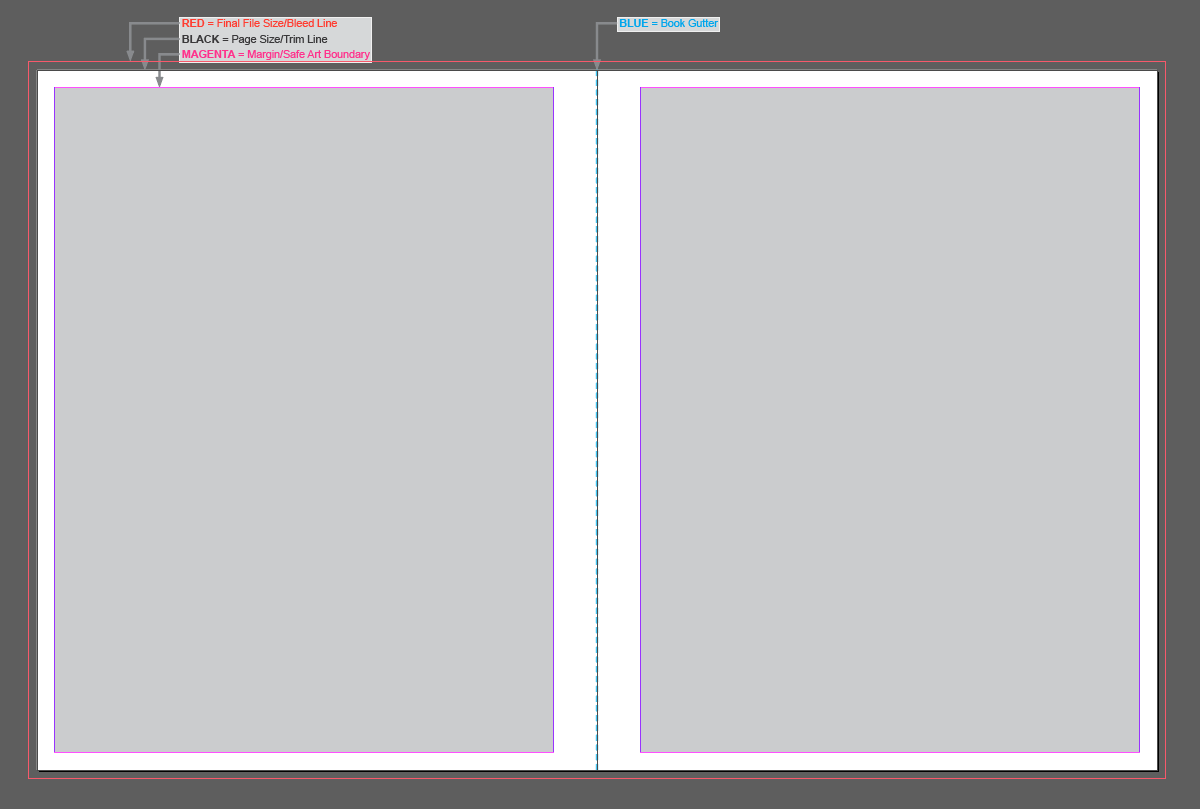
This is what we all start with, a blank spread. This can be intimidating. Like a painter looking at a blank canvas. Now what do I do? Oh no. Here’s the thing. Whatever you do, you can undo. It’s just that simple, so suck it up and make a move. Or in the words of Cobra Kai, “Sweep the leg!”
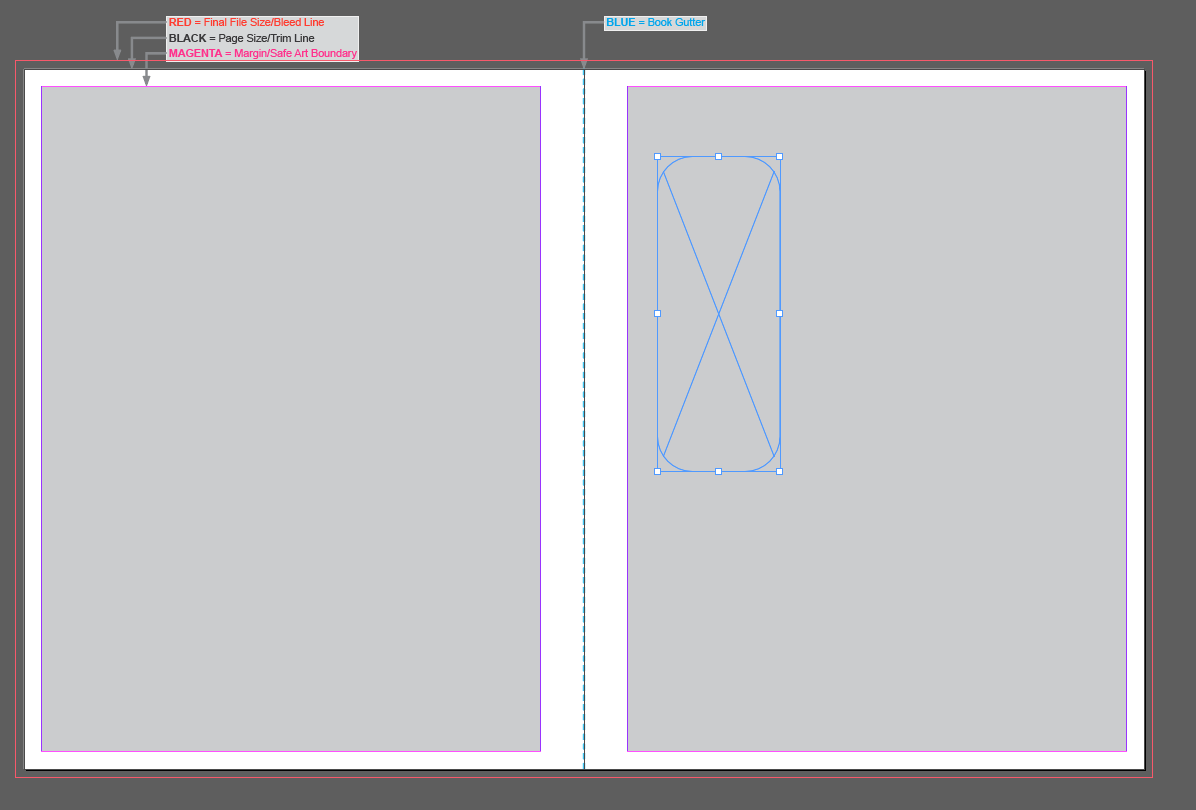
I started with a simple container but rounded the edges. My idea is to create a page of these containers then link them together before filling them with an image.(Basic stuff.) Once they are linked, a single image will spread across all containers. The image is a painting I made several years ago, but the image doesn’t matter because it will be swapped out for an image I make in Japan. You can create any kind of shape or character or vector. My Antarctica portfolio uses atypical triangles on both the front and back.

Once I import the image I can move it however I like. In this case I made sure the eyes of the portrait were coming through the containers. Once at this point, I left this page and decided to work on the opposing page. I knew this page wasn’t complete but there is no rule saying you must complete one before moving on to the other. Books are a process of continual revision. This is why people typically print multiple proof copies before finalizing their run.
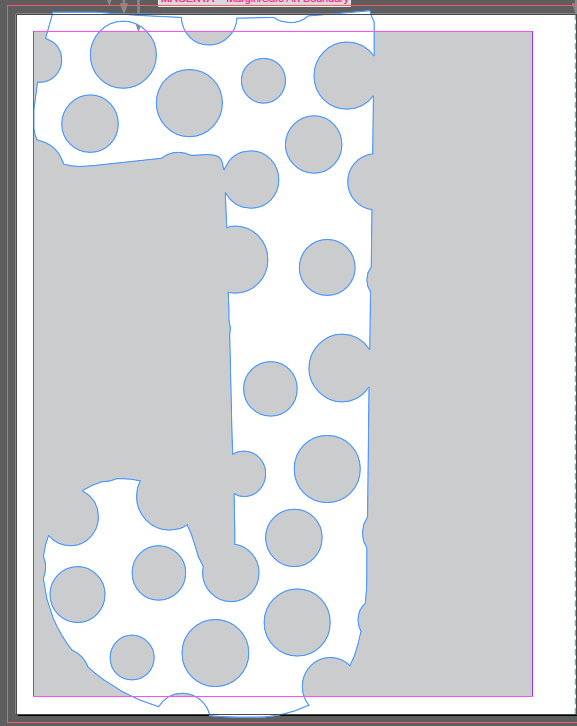
I then decided to use the word “Japan.” I might do the same thing for the Spain journal which I’m starting soon as well. I wanted a typeface that was different, odd, fun and would allow for some interesting manipulation after the book is printed. Love the look and feel of this font. Love the holes. I also wanted the first letter to dominate the entire page. And I wanted to bleed it off the edges. Again, there wasn’t anyone telling me to do this, nor was there a guide I was following. It’s just free expression of whatever I was feeling at the moment.

The letter wasn’t popping like I wanted so I put a black background in then arranged it behind the letter. This works for me for two reasons. One, it solves the letter popping issue, and I could also add a drop shadow to enhance this even further. And two, it means I can then work over the edges of this page with my white gel pen, something I love doing. Other colors are possible two. Typically, I do NOT use black backgrounds in my photography books unless the subject matter demands it.
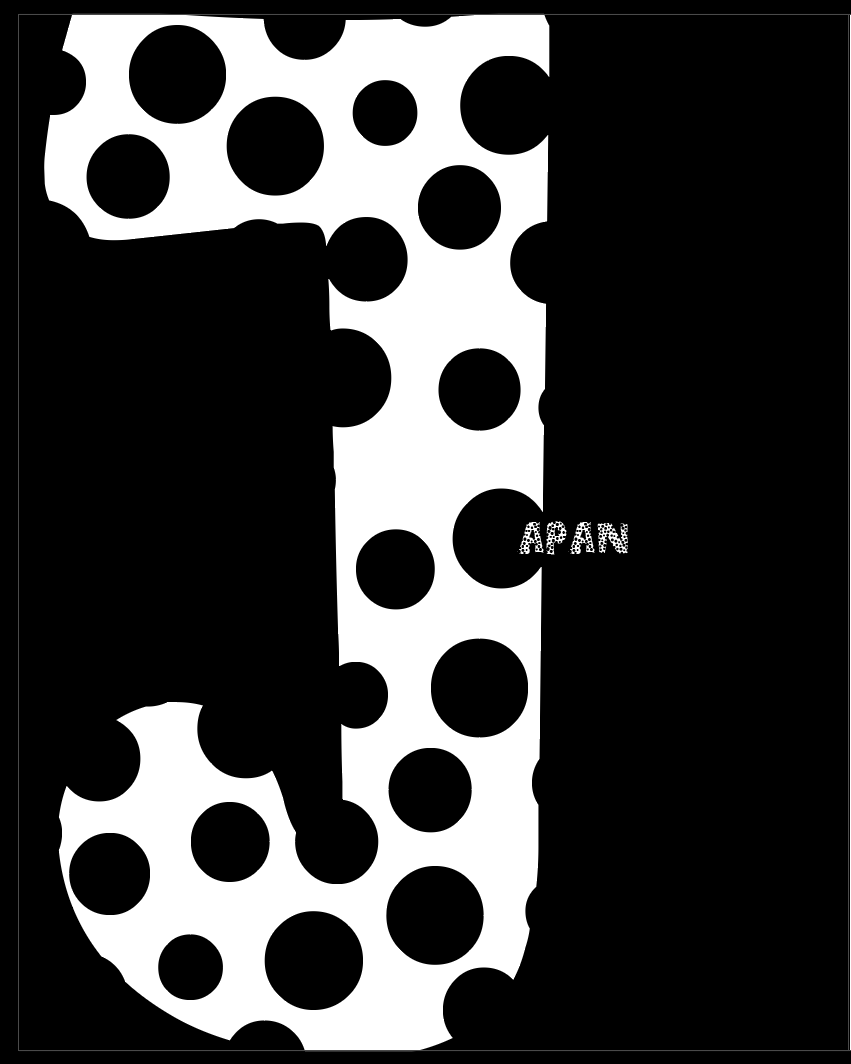
I then added the rest of the title and experimented with placement from the far edge of the page to completely inside the center circle. I also experimented with size, but remember my friends, this is a notebook so not intended for public consumption. The only person who will see these finished pages is me. And anyone telling you your work needs to be seen to matter has both a major insecurity issue and has probably spent the last decade of their life selling something, building audience, maximizing revenue or all the above. This is an ideology driven by addiction, FOMO and detachment from the real world.
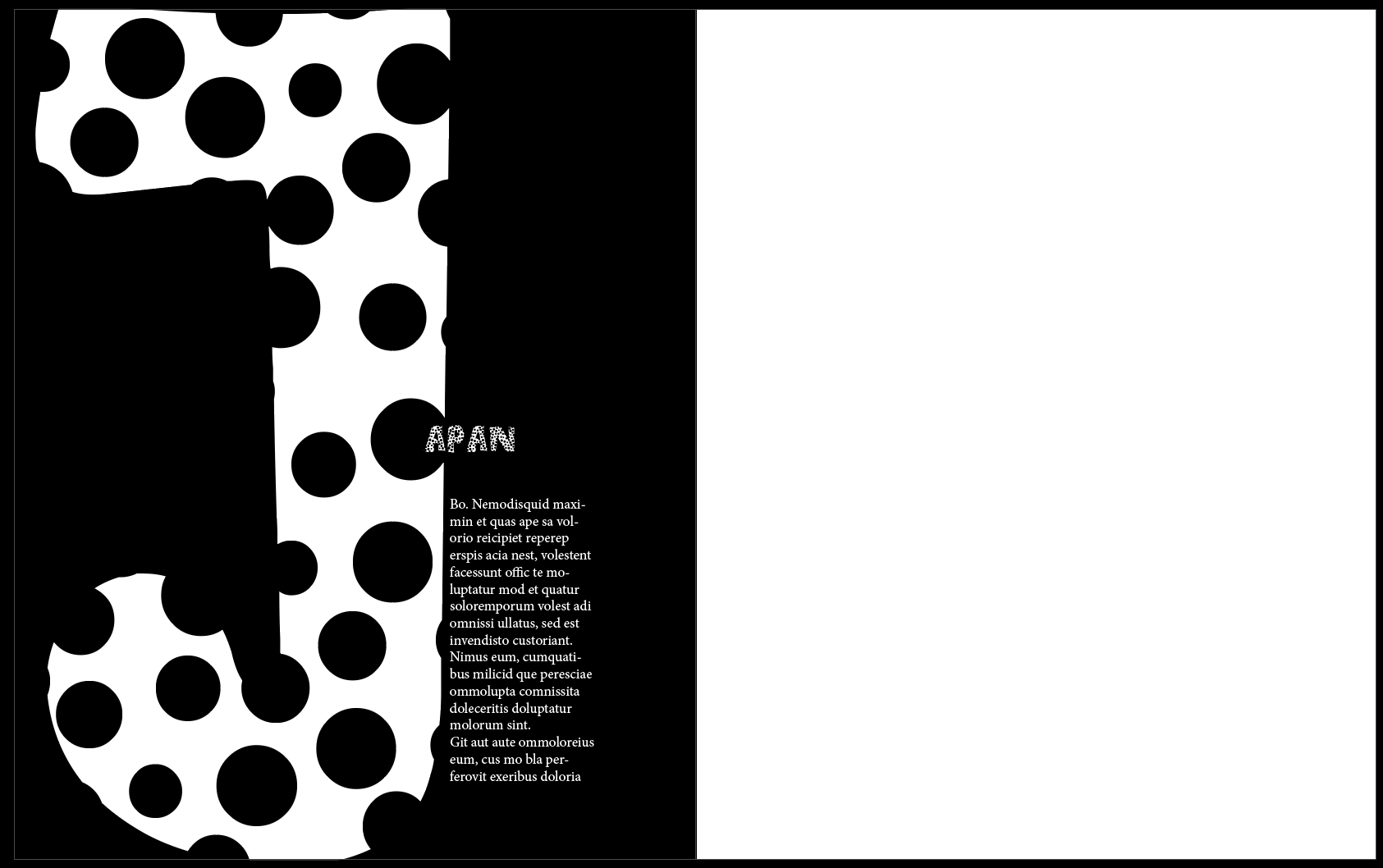
I then added a small copy block which I will replace with real text during or after the trip. I love the combination of type and handwriting, and I also think adding these blocks forces me to write and understand my thoughts while I’m in country. If you don’t write you simply won’t remember all the details. That is not how the brain works. I consider writing to be the high art, and at this point in my life, I give writing equal par with the photography. A single line of good copy is as powerful as a single, strong image.

This started to become something I was interested in looking at, and something I was interested in modifying after the fact. I like the black streaks of acrylic from the painting matching with the black background. I could see black, vertical handwriting in between the shapes on the right page and white gel pen over the left page. But something still felt lacking.
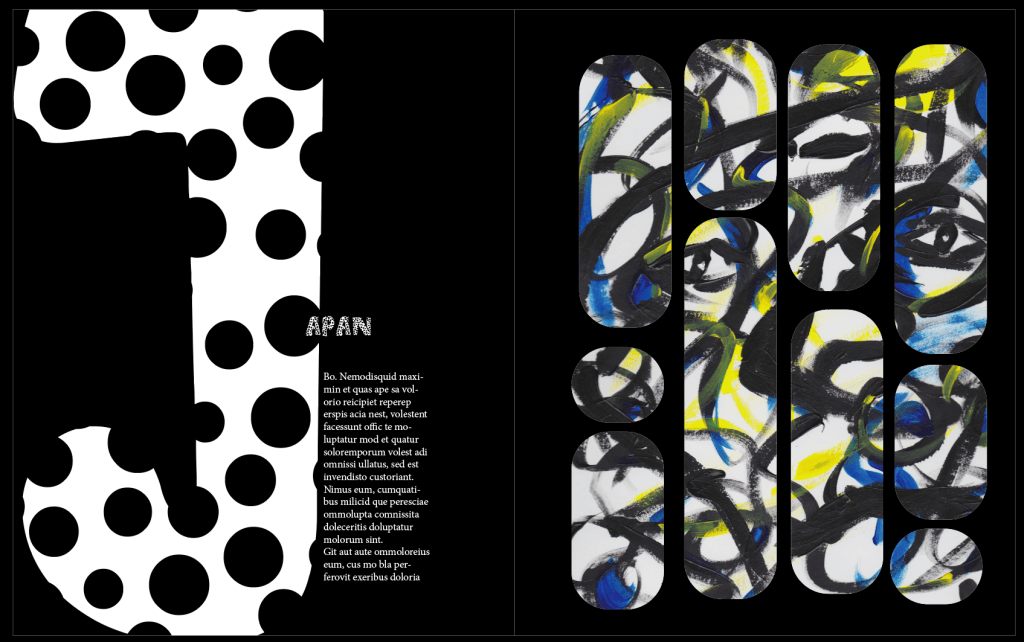
This felt better. But if I was looking at this as a book spread I would not be entirely happy with it. This is more of a magazine style page than a book style page. I think magazine works great for notebooks and journals, less so for photography books although I’m rapidly tiring of classic photography books. I have hundreds already and unless the work is completely off-the-hook they just don’t resonate like they once did. I’d much rather see a photographer’s journal than their finished photobook.
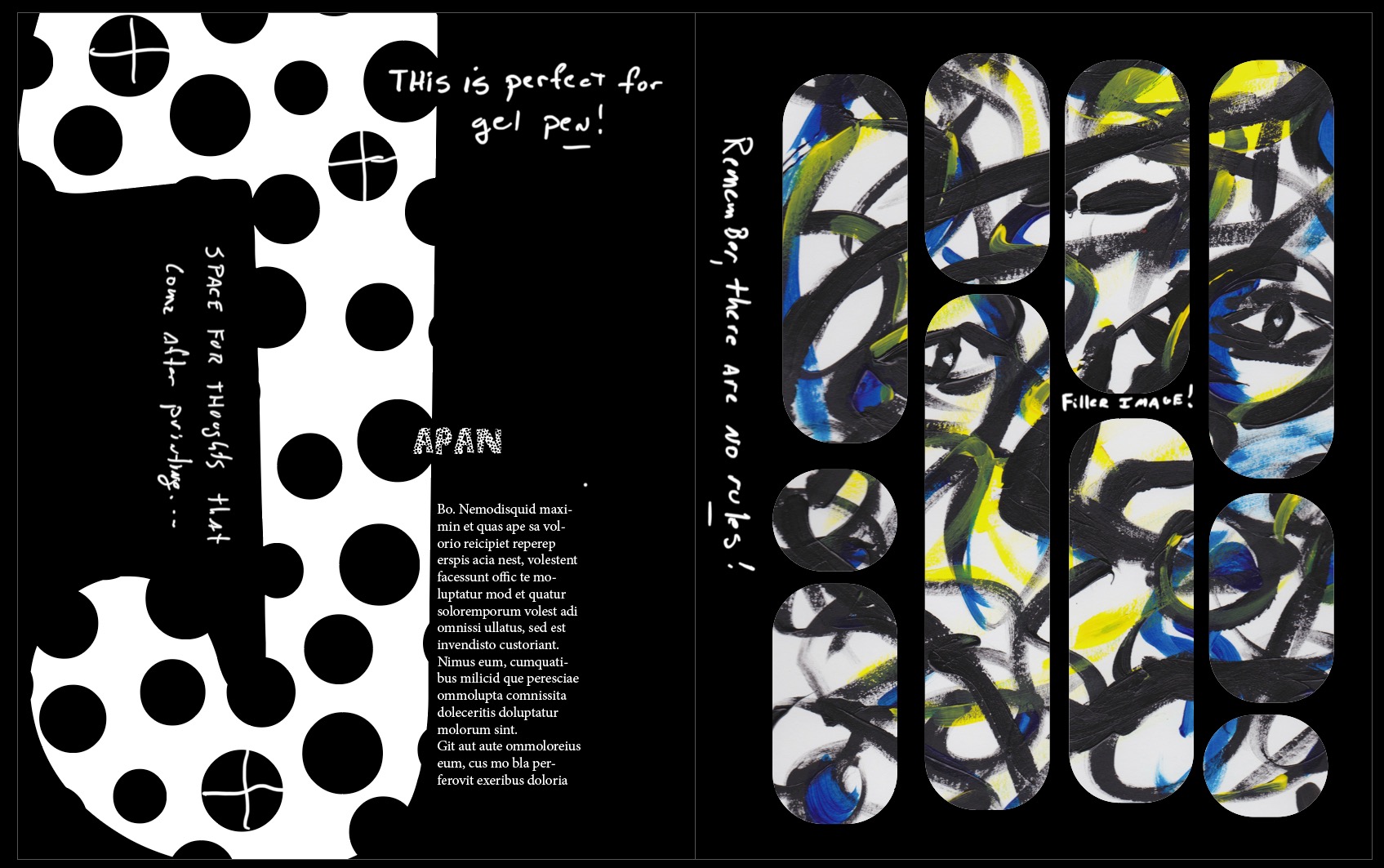
Now you can begin to see how this will look when finished, sometime in 2025. I will replace both the image on the right, and the copy on the left, and I will “finish” the spread with my writing, notes, overheard conversation, etc. Now, imagine an entire book built this way. Some simple spreads with nothing but images, those that are deserving, and only those, and other spreads that will be entirely blank and left for only the handwriting.
My Spain class isn’t until May and my Japan class isn’t until September, but you can see I’m already using some of my free time, which is limited I will admit, to get a jumpstart on what I will create while helping others make their own work and publications. I know for some of you the goal is simply to shoot and post to Instagram. If that is your goal then so be it, but for those of you who are looking for a bit more depth, connection, thought and challenge, I think building books or publications of some sort is worth the effort. There is a reason why every single high level photographer I know wants a book deal.
And if you have a workshop on your horizon, put some thought into your plan before you go. Again, don’t visualize the images you think you are going to make, a mistake I made ONCE during my early newspaper days, but think about what story or theme you want to investigate, how you want to encapsulate your thoughts and images, and push yourself. There is no reason to take a workshop unless you are going to push yourself, try new things and fail. Yes, fail.
Comments 31
I have always wondered about workshops, specifically whether you can attend a workshop with a clear idea of what you want to achieve but not have enough time to execute it. For instance, the workshop is for a group of people, you have to cater to their preferences and visit different locations, which may not align with your own goals. In such cases, each person may have an idea of what they want to shoot, but that doesn’t necessarily mean that everyone will get a chance to fulfill their individual goals.
I am curious to know how this works. Have you encountered instances where people preferred to stay with a particular subject or scene for longer, or where they didn’t want to explore certain locations? I hope my questions make sense.
Author
Anytime you have a group you will have differing points of view, desires, etc. but you can’t allow yourself unrealistic goals. Your job during a workshop is to react to what is in front of you because that is how it works as a photographer. You have to learn to make your pictures no matter where you are, no matter the subject matter. Not to mention, students learn from each other because we critique as a group. The goal of a workshop is to take creative risk while trying new things. If you want to go on a workshop to make the same pictures you make a home, or attempt to walk away with a complete essay, probably better off just traveling on your own. My best experiences taking workshops didn’t even come from the images. Came from the discussion with the instructor. Career changing things.
Yeah, fair point. I suppose if someone has an idea of an essay they wouldn’t choose to do it on a workshop. Like you alluded to, they’d go on their own.
Author
You can do an essay during a workshop. I did. I mentioned this a few posts ago. Did my research, gained access and permission, made a plan, blew off most of the classwork. However, by week’s end I had six pictures total. And realized what I gained most from the class came from ONE conversation with the instructor at the very end. It was a career changing conversation, and had nothing to do with the work. And making six keepers in one week was highly unusual. I was in a target rich environment and made the most of it.
I see. So you were able to cherry pick aspects of the workshop you wanted. You were still able to get what you wanted out of it.
Did you come away with a great essay or just great pictures?
Author
I got far more out of it than I imagined. Again, this was 1997, and I’m still utilizing things I learned in that class. The images became secondary and made me realize a photo workshop is about a lot more than photography.
Fair enough. Thank you for taking the time to reply.
I don’t see any way to link shapes
Author
This was done in InDesign…
Dan, was this made with the blurb software? If so, I’m way behind the curve!
Author
Hey Paul, no this was done in the Blurb, InDesign Plugin. I’m attempting to learn more about InDesign at the moment…
Ok! Thanks! I feel slightly less dumb…but now I feel I need to learn InDesign!
Author
IF you are serious about design, it’s a must. Or something like Affinity. The Blurb software is great, and serves the purpose of working for a wide audience base, but it’s limited in comparison to things like ID.
Thanks!
« And anyone telling you your work needs to be seen to matter has both a major insecurity issue and has probably spent the last decade of their life selling something, building audience, maximizing revenue or all the above. »
I’ve seen a video like that in my YT feed, but it was from a guy who makes videos about making videos of his « cool » office space designed for YT video making. So yeah, no thank you…
Author
This is happening a lot now because many of these folks have never done anything that wasn’t built for the audience first and the work second. That’s why there are so few original image makers out there.
Two years ago, for a short period I’ve been contributing to a community of photobook enthusiasts on the web, all photographers. What I took away from that experience was that many photographers (not all) mostly care about their own photobooks, about other’s books not so much. In addition, this community reminded me of a photo club, which turned me off. So that was that. Another observation of mine was that at least for me, it had been impossible to reach an audience outside the photographic community. Clearly, photobooks are not for everyone – most “civilians” care about the subject of a photograph, not so much about the aesthetics of the work – but I found that a bit disappointing, to say the least. Sorry that this comment is a bit off-topic; it would have fit better to your “Outside Influence” article.
I found the last couple of your articles very interesting and inspiring. It would be a pity if they would eventually perish, like most other content on the web. They would deserve to be collected in a book instead.
Author
Great comment young lad. Perhaps worthy of a second post. Photography, if not treated carefully, can turn one selfish, self-centered and driven by I, me and no one else. Heck, at times the job almost demands it. I know when I was shooting jobs I was as much of a control freak as I could be because it stacked the deck in my favor. So, let me address your points. Photographers selling their own book without buying the work of others is common, but I do know plenty of photographers with massive collections, including myself. You can’t regulate behavior, and modern online photographers are terrible culprits in this regard. Oh well. Next, it is NOT impossible to reach an outside audience. The outside audience is, in fact, what allows publishers to make the books in the first place, but you need to understand the difference between artist driven and story driven, which is the kind of thing you learn in a workshop. In detail. I know someone who sold $250,000 worth of books last year alone, and these were not purchased by photographers. Most photographers don’t have any idea who this guy is. I know someone else who sold 90,000 copies of their last book. Young lad, there is much, much, much to learn. I would caution against any group comprised of only photographers. Too narrow, too limited.
Artist-driven vs. story driven – I have a vague idea what that could mean, but I’m most interested to learn what it actually means. Is it the dichotomy between visual interest (aesthetic) on one hand, and the story/narrative (conceptual/symbolic) on the other? The artists whose work I admire most are able to combine both.
Author
I’ll be sharing more about this over time. It’s an integral part of publishing, but often unknown to those new to the process. And I’ve never heard this discussed in the online world.
Another great article, Dan. I like when one is appreciative of the creative freedom. The online noise has so greatly affected us, that before committing to any work, we subconsciously think – what the viewers want. And I feel, in most of the cases, the people are familiar with the traditional way, and get to connect more when one breaks those traditional rules. I personally love innovative approach more than already laid out paths.
Ps- Total Solar Eclipse is in the next month, and I think New Mexico will marginally miss the visuals. The nearest spot will be I guess San Antonio
Author
I’ll be in San Antonio. I saw the eclipse in 2017. It was unreal, and one of the most incredible experiences I’ve had.
As usual Milnor you have taught me a lot in my reading of this article. I’m glad that I subscribed to Shifter to receive your quality content. Thank you very much, sir.
Regards,
Marina A. Davis
Actually, I have come to realise that photographers’ books can sometimes be a little akin to those beautifully covered LPs of long ago: terrific photo outside, a couple of good tracks on the vinyl but much more mediocre – or downright lousy – packing material to make up the numbers.
As most of us who have been involved in photography for more than five minutes discovers, or eventually has to admit, there is a world of difference between our acceptable images and those few with which we can live over the years. Maybe you have to have been a very busy cat to gather more than a dozen of the latter in a lifetime.
There are always exceptions, though, and I think that of those monographs that I’ve bought, in that respect, perhaps Sam Haskins’ Cowboy Kate is a pretty good – if not the very best buy – as are some Saul Leiter ones. However, even in the case of Saul, I managed to buy one that has disappointed. I wonder if familiarity with the pictures one loves makes them more acceptable than previously unseen ones, such as in that Leiter tome?
As an aside: my tv, about whose lost sound I was breaking my heart, is now alive and well; the tech guy discovered that there was nothing wrong with it, and that the problem lay elsewhere: a malfunction within the little junction box through which passes the broadband signal. So there you go: there is good news sometimes.
Author
Like anything else, quality will vary. I have books that are just so incredibly good they haunt me for years at a time. And others that should have never been published. Famous people get book deals easily, even without the work, but they also get everything else, so this should’t be surprising.
I loved this post learned a lot being a newb to the book side of things. Have put albums/books together for wedding clients, but that always seemed so limited as compared to the world of true creative freedom. Appreciate the insights and wisdom. Could you share more in an upcoming post about the importance of each of the lines you referred to in the basic layout? I understand that they all play into making sure the images/copy appear the best possible and objects do not bleed or content gets cutoff, but will these always be constrained and vary in size to the pages and templates offered by different print vendors/designers?
Author
Sure, I can do that.
That painting is incredible. It’s been a while since I’ve used Mag…forgot the name, the quiet subsidiary of Blurb. Partly because I found In Design difficult. I need to give it another shot.
Had no idea you could link containers.
Author
Ha, the funny part is I don’t have any real memory of making that painting. I started it, finished it, looked down but don’t remember THINKING about making it. And yes, you can do ANYTHING in InDesign.
At 81 and semi-retired, the books I create are for my family, audience 4. Grand kids are on their own. I love Indesign and have learned a great deal about the art of graphic design: placement, size, form, font, etc. It’s the tool I’m using to create my family book and make the book more memorable than a 35mm slide show (per-Powerpoint). My first camera was a Kodak box camera in 1958. I’ve worked with RB 67, Wista 4×5, my first love, a Pentax ME (1978) and now I’m digital. What I’ve learned from this journey into light and objects that capture my attention is how best to capture the object so as not to bore anyone. If they are bored, then I don’t communicate. I’ve got thousands of images of rock outcrops all over the west, whose meaning and significance are for me only. In fact those images haven’t even been digitized or stored on a flash drive. Who would want to see the Morrison and Dakota outcrop in Morrison, Co? My family considers these boring. Thanks David for the insightful commentaries on photography and the other topics.
Author
My family is bored by me as well. And heck, who doesn’t want to se the Dakota outcrop? You had me at “rock outcroppings.”